
Last updated: February 18, 2026
Key Takeaways
- Just-in-time inventory reduce holding costs and obsolescence risk through shared visibility and synchronized planning.
- Streamlined reverse logistics with multi-level repairs handles tens of thousands of devices weekly, delivering cost reductions and faster turnaround times.
- Compliance frameworks such as CMMC, NIST, and SOC II protect against cyber risk while keeping the IT supply chain audit-ready.
- Partnering with Premier Logitech delivers end-to-end lifecycle management with 20+ OEM authorizations and $400M+ in savings. Talk to a lifecycle expert today.
1. Run Just-in-Time Inventory for Fast-Changing IT Assets
Why It Matters
Rapid refresh cycles and hardware obsolescence make traditional stocking strategies expensive. Just-in-time (JIT) inventory reduces holding costs while keeping critical gear ready for deployment.
For example, Tech leaders such as Apple and Dell use JIT by tying component deliveries to assembly schedules, which shortens lead times and limits obsolescence. Dell also built custom PCs by ordering components only after customer orders, further reducing obsolescence risk. Apple and Dell are both Premier Logitech’s clients.
Implementation Steps
- Align component deliveries with deployment and project schedules.
- Use POS-driven replenishment for consumable IT items.
- Set up rapid fulfillment partnerships for emergency needs.
- Enable real-time inventory tracking across every location.
Premier Logitech Advantage
Premier Logitech’s DFW logistics hub and 500,000 monthly kitting capacity support rapid JIT execution. Nearshore Mexico operations provide cost-effective buffer inventory for high-priority components.
Contact Premier Logitech for a customized IT supply chain audit to uncover JIT opportunities.
2. Streamline Reverse Logistics for Returns and Repairs
Why It Matters
Device returns and warranty claims can clog operations and frustrate users. Efficient reverse logistics recovers more value and lowers processing costs while keeping turnaround times short.
Implementation Steps
- Use automated RMA processing and tracking systems.
- Define triage protocols for fast device assessment.
- Stand up multi-level repair capabilities (L1-L4) for full coverage.
- Offer rapid exchange programs for mission-critical device categories.
Premier Logitech Advantage
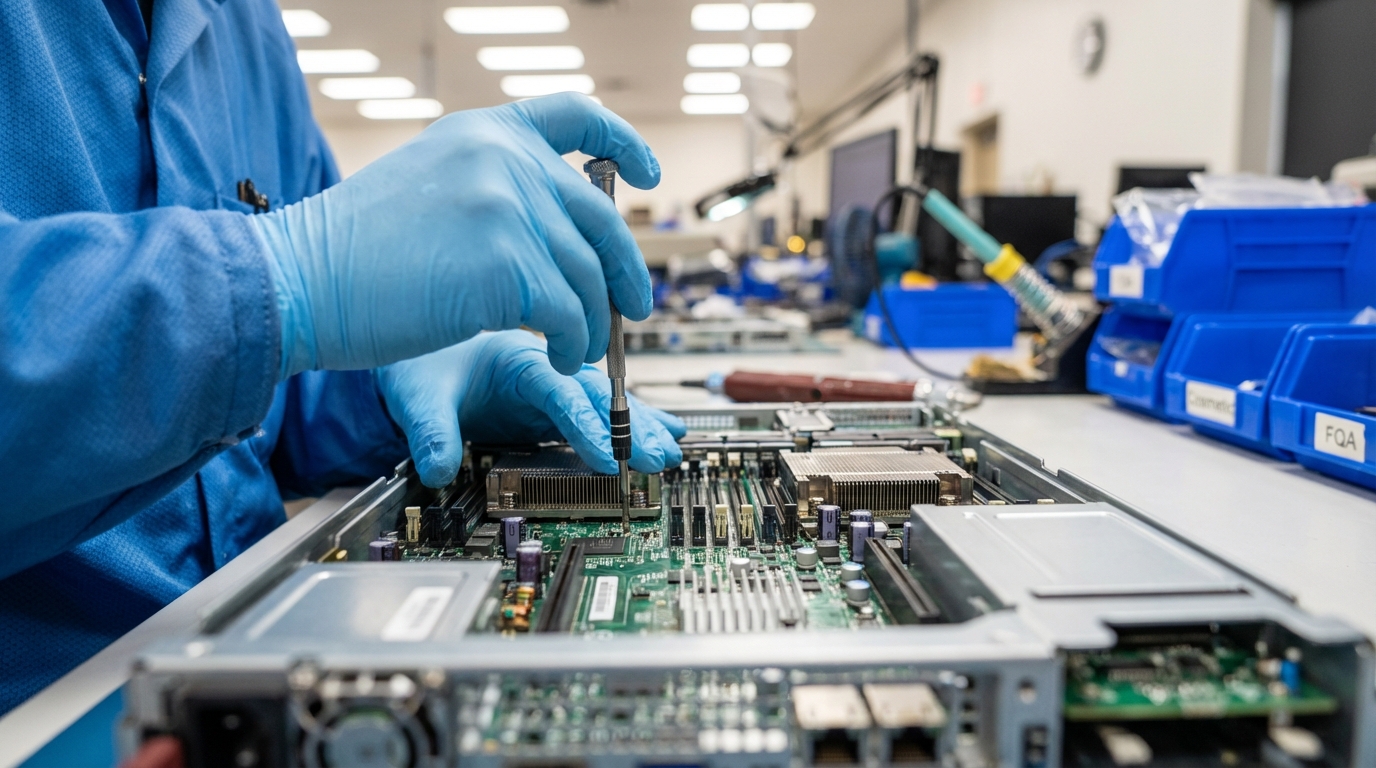
Premier Logitech processes more than 40,000 repairs each week with 20+ OEM Authorized Service Centers (ASC). The team manages RMA intake, refurbishment, and redeployment, with rapid exchange options for critical devices.
3. Build a Proactive IT Supply Chain Risk Program
Why It Matters
Interconnected supply chains introduce cyber vulnerabilities that threat actors exploit. Geopolitical shifts and new regulations also disrupt operations and sourcing.
Implementation Steps
- Map tier-2 and tier-3 supplier dependencies for deeper visibility.
- Run continuous vulnerability scanning on supplier interfaces.
- Develop alternative sourcing for critical components.
- Use scenario-based risk modeling to prepare for disruptions.
Premier Logitech Advantage
Premier Logitech’s CAGE Code 4WAJ9 and certifications such as TAA, NIST, CMMC, and SOC II provide pre-vetted security assurance. Diversified DFW and Mexico operations support continuity when regions face disruption.
4. Turn Data Visibility into Daily Decision Support
Why It Matters
Limited visibility creates blind spots that block proactive decisions. Real-time analytics enable faster responses and continuous improvement across the IT supply chain.
Implementation Steps
- Deploy IoT sensors for asset tracking and condition monitoring.
- Use digital twin technology for scenario modeling.
- Build real-time dashboards for operational KPIs.
- Apply predictive analytics for maintenance and replacement planning.
Premier Logitech Advantage
Premier Logitech’s TMS and lifecycle analytics platforms give end-to-end visibility from procurement through disposal. Real-time reporting and predictive insights highlight where to cut costs and improve performance.
5. Embed Compliance and Security into Every IT Asset Flow
Why It Matters
DoD’s CMMC 2.0 raises cybersecurity expectations for contractors, and CISA’s attestation form requires vendor self-attestation to SSDF practices. These requirements reshape how organizations manage IT supply chains. Coverage, Integrity, Responsiveness, and Software Assurance metrics provide a complete view of compliance performance.
Implementation Steps
- Track SBOMs for full software component visibility.
- Use multi-factor authentication for all supply chain access.
- Run continuous compliance monitoring and reporting.
- Maintain audit trails for every asset lifecycle activity.
Premier Logitech Advantage
Premier Logitech holds TAA, NIST, CMMC, and SOC II certifications and offers secure data destruction with detailed audit reporting for government and enterprise clients.
Schedule a compliance assessment with Premier Logitech to confirm your supply chain aligns with 2026 regulations.
6. Automate Procurement and Fulfillment at Scale
Why It Matters
Manual procurement slows deployments and introduces errors. Automation speeds processing, improves accuracy, and supports consistent policy enforcement.
Implementation Steps
- Trigger automated purchase orders from inventory thresholds.
- Adopt electronic invoicing and payment processing.
- Automate quality control and receiving workflows.
- Offer self-service portals for routine procurement requests.
Premier Logitech Advantage
Premier Logitech’s integrated procurement and fulfillment platform automates orders, inventory management, and deployment coordination. A 500,000 monthly kitting capacity and direct OEM relationships keep sourcing streamlined.
7. Build Circular Economy and Sustainability into IT Lifecycle
Why It Matters
ESG traceability now includes mandatory Scope 3 reporting, and circular economy models cut waste, extend product life, and reduce reliance on virgin materials.
For example, Apple’s use of recycled materials shows how OEMs can integrate circular practices and achieve measurable environmental impact reductions while maintaining quality. Apple is a client of Premier Logitech Advantage.
Implementation Steps
- Stand up device refurbishment and redeployment programs.
- Run responsible recycling and e-waste reduction initiatives.
- Use blockchain for supply chain traceability and ESG reporting.
- Offer take-back programs for end-of-life equipment.
Premier Logitech Advantage
Premier Logitech’s ITAD services cover certified refurbishment, secure data destruction, and responsible recycling. Detailed ESG reporting supports Scope 3 emissions tracking and corporate sustainability goals.
8. Consolidate with an End-to-End Lifecycle Service Partner
Why It Matters
Managing many vendors creates coordination gaps and inconsistent service. End-to-end lifecycle partners align every stage of the asset journey and reduce vendor management workload.
Implementation Steps
- Consolidate multiple service providers under a single partnership.
- Define integrated service level agreements across lifecycle stages.
- Use unified reporting and analytics across all services.
- Design scalable service models that flex with demand.
Premier Logitech Advantage
Premier Logitech delivers sourcing, deployment, support, and recycling through modular services that scale with business needs. Its carrier network, nearshore operations, and a strong compliance framework remove vendor fragmentation.
How Leading Enterprises Execute IT Supply Chain Transformation
Mature reverse logistics programs achieve faster turnaround times than fragmented approaches. Enterprises that integrate these practices see measurable gains.
For example, Dell’s JIT program reduced lead times and limited obsolescence through tightly coordinated component deliveries.
Dell is a client of Premier Logitech. The company stands apart from competitors through its IT specialization, DFW logistics hub near major transportation routes, and broad OEM authorization portfolio. The company’s CAGE Code 4WAJ9 and nearshore Mexico operations give government and enterprise clients secure, cost-effective lifecycle management options.
Frequently Asked Questions on IT Supply Chain Optimization
Key Metrics for IT Supply Chain Performance
Core metrics include inventory turnover, order fulfillment accuracy, reverse logistics processing time, total cost of ownership, and compliance audit scores. Leading organizations also track e-waste diversion and circular value recovery. Dashboards should highlight both operational efficiency and strategic outcomes such as cost reduction and risk mitigation.
Role of Reverse Logistics in IT Supply Chains
Reverse logistics manages returned, defective, or end-of-life devices for repair, refurbishment, or recycling. Strong programs reduce waste, recover asset value, and support circular initiatives while maintaining data security and environmental compliance. Faster replacement cycles also improve total cost of ownership and user satisfaction.
AI Tools That Matter Most in 2026
High-impact AI tools include predictive demand forecasting, automated exception detection for disruptions, generative AI for scenario planning and reporting, and conversational assistants for faster planning cycles. IoT integration provides live visibility, and digital twins support detailed risk and optimization modeling.
Staying Compliant with CMMC, NIST, and Related Standards
Compliance depends on strong documentation, continuous monitoring, and certified partners. Organizations should track SBOMs, maintain audit trails for all asset activities, enforce multi-factor authentication, and produce detailed compliance reports. Working with pre-certified providers reduces internal burden and supports adherence to evolving standards.
Value of an End-to-End Lifecycle Partner
End-to-end partners remove coordination friction, unify service levels, and centralize reporting across the lifecycle. This model reduces vendor management effort, improves consistency, and enables holistic optimization.
Premier Logitech combines OEM authorizations, compliance credentials, and scalable operations to handle complex IT lifecycle needs while delivering measurable savings and performance gains. Talk to a lifecycle expert to design a tailored optimization roadmap for your organization.
Conclusion: Next Steps for Your 2026 IT Supply Chain
Effective IT supply chain transformation in 2026 requires coordinated action across several areas:
- Just-in-time inventory strategies.
- Efficient reverse logistics operations.
- Embedded compliance and security frameworks
- Integrated supplier platforms.
Premier Logitech’s end-to-end lifecycle services, broad OEM authorizations, and record of delivering more than $400 million in client savings make the company a strong starting point for supply chain transformation. Its integrated model removes vendor fragmentation and supports the scale and compliance needs of complex enterprises.
Partner with Premier Logitech for data-driven IT supply chain transformation. Talk to a lifecycle expert and start preparing your operations for 2026 and beyond.