Last updated: April 17, 2026
Key Takeaways
- Five main drivers – facilities, inventory, transportation, information, and sourcing – shape supply chain performance through clear trade-offs between efficiency and responsiveness in tech environments.
- Facilities now favor nearshore distributed networks like Premier Logitech’s DFW and Mexico operations, which improve resilience and support repair capabilities processing 40,000+ units weekly.
- Inventory strategies shift from JIT to JIC, with AI forecasting cutting stockouts and excess while supporting high tech return volumes.
- AI-powered information systems and transportation networks create real-time visibility, rapid exchanges, and up to 15% emissions reductions.
- Premier Logitech integrates all five drivers to deliver up to 40% cost savings and compliance; see how this integrated approach can transform your operations.
1. Facilities: Nearshore Networks for Tech Production and Repair
Facilities include every physical location where production, assembly, repair, and storage occur. In technology supply chains, this covers manufacturing plants, repair depots, distribution centers, and nearshore operations that manage device lifecycles from initial assembly through end-of-life processing.
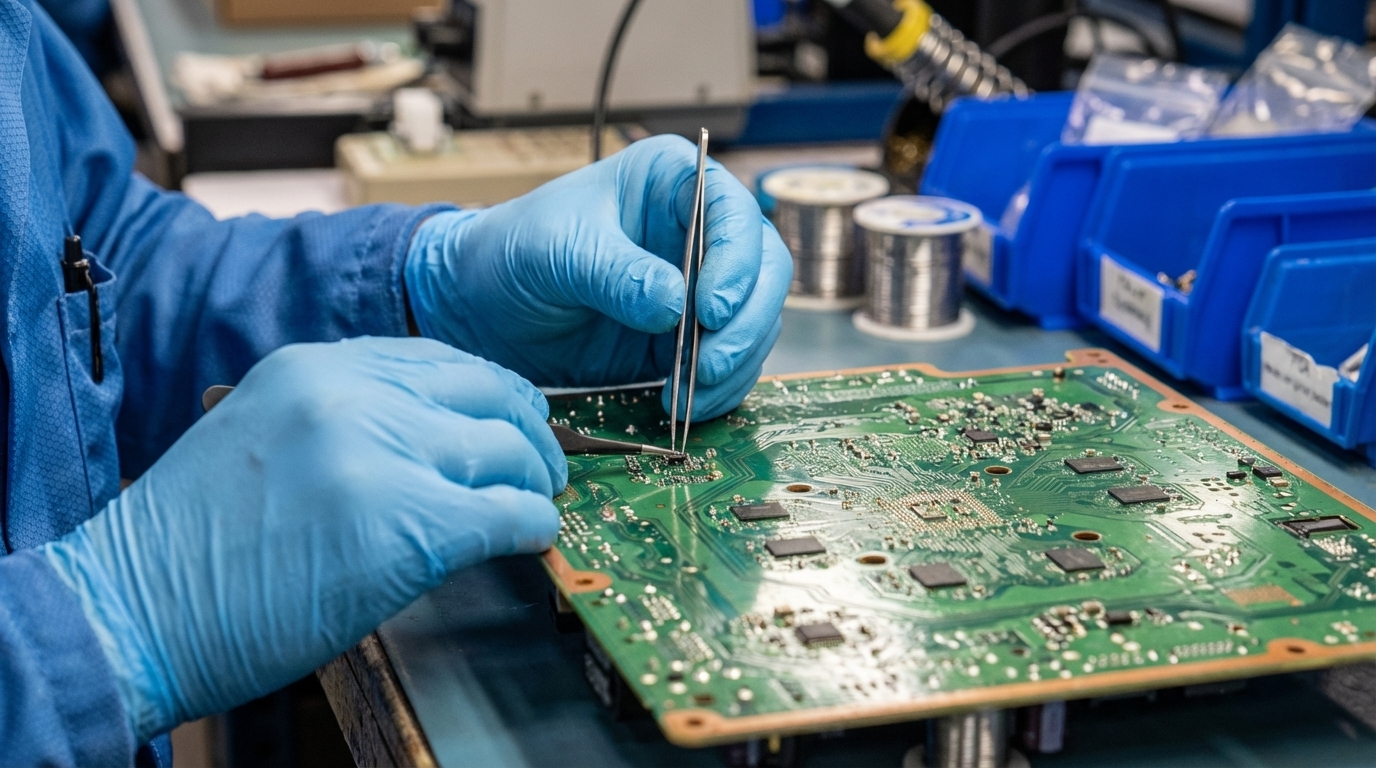
Traditional facility strategies prioritized offshore locations to minimize labor costs. However, the shift from offshoring to friendshoring now prioritizes political allies and neighbors, raising production costs but improving security and responsiveness. Premier Logitech’s DFW facilities and Mexico nearshore operations follow this model, cutting e-waste through comprehensive L1-L4 repair capabilities that process over 40,000 repairs weekly.
The efficiency versus responsiveness trade-off appears clearly in facility decisions. Centralized mega-facilities deliver economies of scale but create single points of failure. Leading organizations now replace concentrated facilities with distributed networks of smaller, automated factories that strengthen regional resilience.
AI technologies further improve facility performance in 2026. Predictive maintenance monitoring reduces unplanned outages. Intelligent automation supports Premier Logitech’s ASC status for 20+ OEMs and enables superior repair yields through advanced diagnostics and tight quality control.
2. Inventory: AI Forecasting for JIT, JIC, and High Returns
Inventory management balances raw materials, work-in-progress, and finished goods to meet demand while controlling carrying costs. Technology companies face unique inventory pressure from rapid product obsolescence, high return volumes, and complex component dependencies that require precise forecasting and buffer strategies.
The inventory driver changed significantly as supply chains moved from Just-in-Time minimal stock approaches to Just-in-Case strategies. JIC safety buffers and higher stock levels increase warehouse costs but reduce shortages. Premier Logitech manages this complexity through 500,000 monthly kitting operations for returns and refurbishments, which helps balance inventory across multiple product lifecycles.
AI-driven forecasting reshapes inventory planning. AI cuts forecast errors, lowers safety stock levels, and reduces stockouts while freeing excess capital tied up in inventory. Advanced algorithms analyze thousands of SKUs at once, remove manual guesswork, and prevent overbuying of items that soon become obsolete. These capabilities translate directly into measurable inventory reductions.
Organizations that implement these AI systems early achieve lower inventory levels through better visibility and predictive accuracy. This reduction becomes critical in tech environments where component costs change quickly and product lifecycles keep shrinking.
3. Transportation: Carrier Networks for Fast IT Replacement
Transportation covers all freight modes and logistics networks that move goods from suppliers to customers. Technology supply chains need specialized transportation for fragile electronics, rapid replacement programs, and reverse logistics flows that handle warranty returns and device exchanges.
Transportation choices always balance speed and cost. Air freight delivers fast service at premium prices. Rail and ocean transport offer lower costs with longer transit times. The EU’s Carbon Border Adjustment Mechanism pushes nearshoring to avoid carbon taxes, trading long-distance efficiency for regulatory compliance and shorter-route responsiveness.
Premier Logitech’s network of 120+ vetted LTL carriers supports next-day replacement programs that matter for enterprise IT operations. This distributed carrier model provides broad geographic coverage and maintains cost efficiency, while avoiding single-carrier dependencies that create service risk.
AI optimization improves transportation performance further in 2026. Agentic AI systems cut decision latency by autonomously re-routing shipments when they detect disruptions. These systems also shorten lead times through dynamic routing and continuous carrier optimization.
4. Information: Control Towers for Real-Time Tech Visibility
Information systems manage data flow and analytics that support real-time supply chain decisions. Technology companies need advanced information capabilities to track complex product configurations, manage warranty claims, monitor repair status, and coordinate reverse logistics across many channels and regions.
Traditional ERP systems handled basic transaction processing but lacked real-time visibility and predictive insight. Agentic AI control towers now replace spreadsheets and limited ERP views, providing 24/7 visibility through high-tech investments that balance complexity with rapid response.
Premier Logitech’s Transportation Management System illustrates these advanced information capabilities. The TMS provides real-time tracking across repair depots, fulfillment centers, and customer locations. This visibility supports proactive exception management and fast responses when service disruptions occur.
Organizations using agentic AI systems report double-digit efficiency gains through autonomous decision-making and predictive analytics. AI adoption can also cut total emissions from freight logistics by up to 15% while enabling rapid scenario modeling that suits volatile tech markets.
Transform your supply chain visibility with AI-powered solutions. Explore how Premier Logitech’s TMS and control tower capabilities deliver the real-time insights your operations need.
5. Sourcing: Aggregated Vendors for Secure, Compliant Tech
Sourcing strategies determine whether organizations produce internally or rely on external suppliers. Technology companies manage complex sourcing decisions across component suppliers, manufacturing partners, repair providers, and logistics services while maintaining government compliance and strict quality standards.
Traditional sourcing emphasized single-source, low-cost suppliers to maximize efficiency. However, sourcing now evolves from single-source concentration to multi-sourced diversification across three or more friendly nations, which lowers total shutdown risk but increases coordination complexity and cost.
This shift makes supplier relationship quality more critical than ever. Organizations that maintain strong supplier relationships experience fewer supply chain disruptions than those with weaker connections. Premier Logitech’s vendor aggregation approach addresses this challenge by consolidating multiple suppliers for OEM clients, reducing coordination complexity while preserving supply security.
Technology markets also encourage dual-sourcing adoption. Semiconductor companies use dual sourcing to reduce risk exposure in volatile hardware markets. This strategy supports supply continuity but demands sophisticated supplier management and tight quality coordination.
AI improves sourcing decisions through automated supplier evaluation and risk monitoring. Agentic AI can cut supplier onboarding time by up to 50% through autonomous validation of credentials and compliance checks, which enables rapid supplier diversification when disruptions appear.
Balancing the 5 Drivers: Practical Trade-Offs for Tech Leaders
Each supply chain driver forces clear choices between efficiency and responsiveness. Technology leaders who understand these trade-offs can align facilities, inventory, transportation, information, and sourcing with their specific operational requirements and market conditions.
The following table summarizes how each driver presents a choice between cost-focused efficiency and speed-focused responsiveness. These trade-offs guide where to invest and where to accept higher cost for better service.
| Driver | Efficiency Focus | Responsiveness Focus |
|---|---|---|
| Facilities | Offshore mega-plants for scale | Nearshore distributed networks |
| Inventory | JIT minimal stock levels | JIC safety buffers (12-15% premium) |
| Transportation | Rail/ocean for cost optimization | Air freight for speed requirements |
| Information | Basic ERP transaction processing | AI control towers for 24/7 visibility |
| Sourcing | Single-source cost minimization | Multi-source risk diversification |
Premier Logitech’s single-source partnership model aligns all five drivers, delivering up to 40% cost reductions while preserving responsiveness. The company achieves this through integrated facilities, balanced inventory management, broad transportation networks, advanced information systems, and consolidated sourcing relationships.
5 Key Drivers vs. Supply Chain Pillars
Supply chain drivers represent dynamic, operational elements that directly affect performance and can be actively managed and improved. Pillars usually describe static, foundational elements such as organizational structure or strategic principles. The five drivers – facilities, inventory, transportation, information, and sourcing – require continuous tuning and present measurable trade-offs between efficiency and responsiveness.
Premier Logitech: Integrated Driver Management for Tech Supply Chains
Premier Logitech delivers end-to-end technology lifecycle services that align all five supply chain drivers through integrated solutions spanning sourcing through recycling. The company’s approach includes depot repair capabilities, transportation management systems, and nearshore operations built specifically for technology supply chains.
This integrated infrastructure has generated over $400 million in documented client savings, which ties directly to Premier Logitech’s market position. The company holds CAGE code 4WAJ9 for government compliance and ASC authorization for more than 20 OEM brands, setting it apart from competitors like Ingram Micro and Flex that lack this breadth of manufacturer authorization. That authorization enables higher repair yields and faster turnaround times because Premier Logitech technicians use OEM-level diagnostic tools and parts access that non-authorized providers cannot match.
These capabilities create concrete operational advantages. Clients gain ISO 9001/14001 and SOC2 compliance for security and quality requirements, rapid exchange programs for critical device replacements, and comprehensive reverse logistics that manage high return volumes. Premier Logitech’s DFW facilities and Mexico operations add geographic resilience while still controlling cost.
Ready to consolidate your supply chain drivers with a single, authorized partner? Request a consultation to map your current driver performance and identify integration opportunities.
Actionable Checklist: Next Steps Across the 5 Drivers
- Facilities: Audit current locations for nearshore opportunities and evaluate repair capabilities that can extend device lifecycles.
- Inventory: Implement AI-driven forecasting to reduce stockouts, shrink excess inventory, and improve forecast accuracy.
- Transportation: Diversify carrier networks beyond single-source dependencies to improve resilience and service continuity.
- Information: Deploy real-time visibility systems that support proactive exception management and faster decision-making.
- Sourcing: Evaluate dual-sourcing strategies for critical components and services to reduce disruption risk.
- Integration: Assess single-partner consolidation options that align all five drivers under one coordinated operating model.
Leading operations achieve meaningful productivity gains by improving each driver and then aligning them, which positions organizations for competitive advantage in 2026’s dynamic technology markets.
Frequently Asked Questions
What are the 5 key drivers vs. pillars of supply chain performance?
The five key drivers – facilities, inventory, transportation, information, and sourcing – represent dynamic operational elements that directly affect performance and require continuous improvement. Pillars usually describe static foundational elements such as organizational structure or strategic principles. Drivers create measurable trade-offs between efficiency and responsiveness, while pillars provide the underlying support framework.
How does AI impact the Information driver in 2026?
AI reshapes the information driver through agentic systems that provide real-time visibility, predictive analytics, and autonomous decision-making. These systems reduce decision latency and support double-digit efficiency gains, while also delivering the emissions reductions mentioned earlier. AI-powered control towers replace basic ERP systems with 24/7 visibility and proactive exception management capabilities.
What are the best ways to optimize reverse logistics drivers?
Reverse logistics optimization depends on tight integration across multiple drivers. Facilities need ASC-authorized repair capabilities. Inventory teams must manage returned products effectively. Transportation networks should support rapid exchanges. Information systems must track RMAs accurately, and sourcing strategies should secure reliable refurbishment partners. Premier Logitech combines these elements through comprehensive depot repair, real-time visibility, and integrated lifecycle management.
How does Premier Logitech optimize supply chain drivers for IT companies?
Premier Logitech improves all five drivers through integrated services. DFW and Mexico facilities support nearshore operations. AI-enhanced inventory management supports 500,000 monthly kitting operations. A network of 120+ LTL carriers enables rapid exchanges. TMS technology delivers real-time visibility, and vendor consolidation simplifies sourcing. This comprehensive model delivers up to 40% cost reductions while preserving responsiveness for technology supply chains.
What metrics should companies track for supply chain driver performance?
Key metrics include facility utilization and repair yields, inventory turnover and forecast accuracy, transportation on-time delivery and cost per shipment, information system uptime and decision speed, and sourcing supplier performance and risk scores. Leading organizations also track cross-driver measures such as total cost of ownership, customer satisfaction scores, and sustainability metrics to understand integrated performance across all five drivers.
