Key Takeaways for Electronics Reverse Logistics Leaders
- Electronics return rates average 8 to 10% in 2026, so reverse logistics now drives value recovery and compliance performance.
- Follow a 7-step process: assess volume, map 5 R’s requirements, verify certifications like R2v3 and NIST, evaluate technical capabilities, analyze scale, calculate costs, and run pilot programs.
- Use 12 essential questions that cover OEM authorizations, battery compliance, data security, turnaround times, AI usage, surge capacity, and nearshore operations.
- Plan for AI-driven inspection, circular economy programs, and nearshoring, which together cut processing time and reduce handling costs.
- Partner with Premier Logitech for OEM-authorized services, 40,000+ weekly repairs, and proven supply chain savings through DFW-Mexico operations.
Core Concepts You Need Before Selecting a Provider
Supply chain VPs and directors make better decisions when they understand the basics of electronics reverse logistics. The “5 R’s” framework covers Returns processing, Repair and refurbishment, Remarketing through secondary channels, Recycling of components, and Resale of recovered assets.
Electronics reverse logistics differs from general returns processing because of stricter safety and compliance requirements. Lithium battery protocols, data security standards, and OEM Authorized Service Center (ASC) rules create specialized operational demands. Commercial returns now represent a major share of the global reverse logistics market, and electronics drive much of this volume through warranty claims and consumer returns.
Premier Logitech illustrates the level of scale many enterprises now expect. The company supports 500,000 units of monthly kitting capacity, maintains NIST and CMMC certifications, and runs integrated DFW-Mexico operations that enable rapid cross-border processing with lower total landed cost.
7 Steps to Select a Reverse Logistics Provider for Electronics in 2026
With these fundamentals in place, you can move into a structured evaluation process. The seven steps below help you assess capabilities, confirm credentials, and select a partner that fits your electronics reverse logistics strategy.
Step 1: Assess Your Volume and SKU Complexity
Start with a clear picture of your current and projected returns. Calculate annual return volumes, warranty claim rates, and SKU diversity across product families. Electronics OEMs typically see 8 to 15% return rates, and smartphones plus wearables often spike higher during upgrade cycles.
Step 2: Map Your 5 R’s Requirements
Clarify how each product category will move through the 5 R’s. Define which returned products need repair, refurbishment, remarketing, recycling, or resale. Electronics often require specialized handling for lithium batteries, secure data wiping, and component harvesting that supports circular economy initiatives.
Step 3: Verify Critical Certifications
Confirm that each provider holds the certifications your business and customers expect. Look for NIST cybersecurity frameworks, CMMC compliance, R2v3 electronics recycling standards, TAA compliance for government contracts, and ISO 9001/14001 quality management. R2v3 certification provides a comprehensive framework for managing the entire reverse supply chain while maintaining strong data security compliance.
Step 4: Evaluate Technical Capabilities
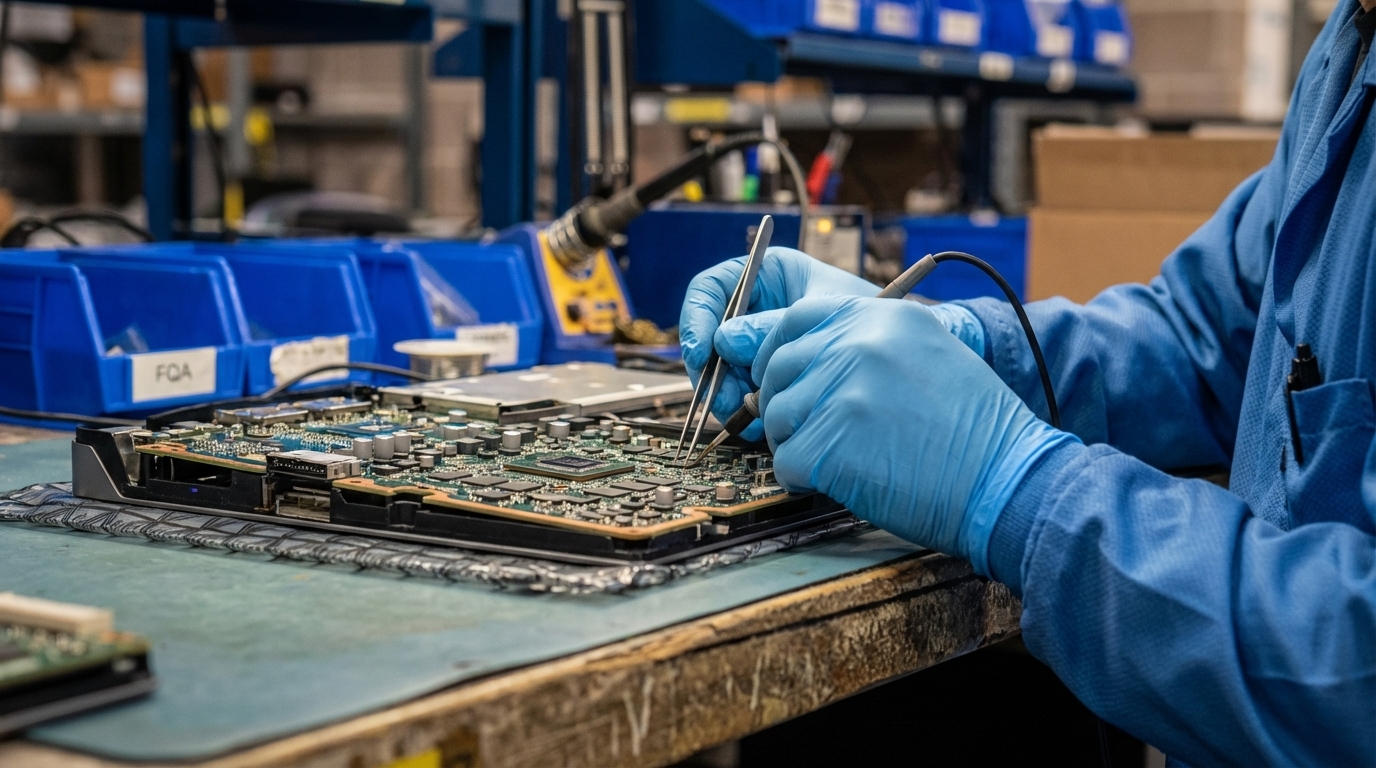
Match provider repair depth to your product complexity. Assess repair capabilities from Level 1 diagnostics through Level 4 component-level repair. AI-powered sorting robots and automated inspection systems now support high-volume processing as a standard capability. Providers such as Premier Logitech reach 40,000+ weekly repairs by combining advanced diagnostics, automation, and experienced technicians.
Step 5: Analyze Scale and Speed Metrics
Review how each provider manages transportation, warehousing, and service levels. Examine Transportation Management Systems, warehouse automation, and service level agreements that define turnaround expectations. Leading providers achieve sub-48-hour turnaround times by pairing nearshore operations with tightly managed logistics networks.
Step 6: Calculate Total Cost and Value Recovery
Look beyond unit pricing and measure the full financial impact. Evaluate pricing models against value recovery rates, including refurbishment yield, resale margins, and avoided write-offs. Consider freight, handling, and processing costs alongside recovered value to understand true reverse logistics performance.
Step 7: Design Pilot Programs with Scorecards
Test providers in controlled pilots before you commit to long-term contracts. Establish 30-day pilots that measure turnaround times, recovery rates, compliance incidents, and customer satisfaction. These metrics become most useful when you organize them into structured scorecards that let you compare providers objectively across operational and financial dimensions.
When you are ready to launch a pilot, talk to a lifecycle expert about Premier Logitech’s rapid exchange and nearshore capabilities.
12 Questions to Ask Every Reverse Logistics Provider for Electronics
The questions below cover your most critical evaluation areas, from OEM authorizations to technology investments. The first four questions focus on foundational requirements that every serious provider should meet.
| Question | Why It Matters | Red Flags | Premier Logitech Edge |
|---|---|---|---|
| 1. What OEM authorizations do you hold? | Warranty compliance and repair legitimacy | No ASC authorizations | 20+ OEM ASCs |
| 2. How do you handle battery compliance? | Safety regulations and liability | No R2v3 certification | Comprehensive battery compliance programs |
| 3. What data security certifications do you maintain? | NIST and CMMC compliance requirements | Basic data wiping only | NIST and CMMC certified |
| 4. What are your RMA turnaround times? | Customer satisfaction and inventory velocity | Seven-day or longer processing | Rapid turnaround times |
Additional Critical Questions for Provider Shortlists
5. Do you use AI for device grading and inspection?
AI integration for predictive analytics and disposition engines is transforming reverse logistics by enhancing efficiency and reducing errors. Providers without AI capabilities will fall behind on accuracy, speed, and cost control.
6. How do you handle volume surges?
Electronics returns spike during product launches, recalls, and seasonal peaks. Scalable providers maintain surge capacity through flexible workforce models, automated systems, and nearshore capacity that can absorb sudden demand.
7. What Transportation Management Systems do you use?
Modern TMS platforms support real-time tracking, automated routing, and integrated logistics networks. These capabilities reduce transit times and improve visibility across the reverse supply chain.
8. What are your value recovery metrics?
Leading providers track value recovery by grade, channel, and product family. Strong partners achieve high recovery on Grade A returns through efficient processing and established secondary market channels, which outperform reactive or ad hoc approaches.
9. Do you offer pilot programs?
Reputable providers support structured pilot programs with defined metrics, timelines, and success criteria. These pilots give you a low-risk way to validate performance before scaling.
10. What nearshore capabilities do you have?
Nearshore operations in Mexico provide cost advantages while keeping operations close to U.S. markets. Premier Logitech’s DFW-Mexico corridor enables rapid cross-border processing with consistent quality controls.
11. How do you integrate with OEM systems?
API connectivity, EDI capabilities, and real-time data exchange support seamless integration with warranty, service management, and ERP systems. Strong integration reduces manual work and improves data accuracy.
12. What 2026 technology investments are you making?
Automation, robotics, AI-driven diagnostics, and robotic repair systems improve consistency and throughput in high-volume smartphone returns. Providers that invest in these technologies will deliver better performance over the life of your contract.
Latest Trends Shaping Electronics Reverse Logistics in 2026
Three major trends now reshape how electronics reverse logistics operates. AI integration reduces processing errors and cuts costs through predictive analytics and automated disposition engines. Automation in warehouses and sorting facilities further streamlines operations while improving accuracy.
Circular economy programs now drive component recovery and refurbishment at scale. A remanufactured iPhone 15 costs around $480 versus $550 for new units, which creates meaningful margin opportunities. Electronics manufacturers increasingly treat reverse logistics as a profit center rather than a pure cost.
Nearshoring also plays a growing role in strategy. Premier Logitech’s DFW-Mexico operations combine U.S. logistics infrastructure with cost-effective Mexican manufacturing capabilities, supporting faster processing and full lifecycle management.
Avoid Common Pitfalls and Prove Success with Pilots
Many organizations stumble by choosing providers without proper OEM authorizations, strong data security, or adequate surge capacity. These gaps can void warranties, increase compliance risk, and damage customer relationships.
Clear metrics help you avoid those outcomes. Key performance indicators for pilot programs include recovery rates above 70%, turnaround times under 72 hours, zero compliance incidents, and customer satisfaction scores above 90%. Standardized inspection and grading scales reduce variance, speed up triage, and boost recovery rates on Grade A and B items.
Structure 30-day pilots with defined success criteria, agreed metrics, and regular progress reviews. Use scorecards to evaluate providers objectively across operational, financial, and compliance dimensions, then apply those insights to your RFP and final selection.
FAQ: Choosing Reverse Logistics for Electronics
What certifications are most critical for electronics reverse logistics providers?
R2v3 certification for electronics recycling, NIST cybersecurity frameworks, CMMC compliance for government contracts, and ISO 9001/14001 for quality management all play key roles. Together, these certifications support proper handling of sensitive electronics, strong data security, and responsible environmental practices.
How should I test a reverse logistics provider before full commitment?
Run structured 30-day pilot programs with clear metrics such as turnaround times, value recovery rates, compliance incidents, and customer satisfaction. Use scorecards to compare providers objectively and agree on success criteria before you expand the relationship.
What 2026 trends should influence my provider selection?
Focus on AI-driven inspection and grading systems, automated sorting and processing, nearshore operations that reduce cost and transit time, and circular economy capabilities for component recovery. Providers that invest in these areas will deliver stronger performance and competitive advantages.
How do the 5 R’s apply specifically to electronics?
Returns processing for electronics requires specialized handling for lithium batteries and strict data security. Repair spans Level 1 through Level 4 technical capabilities and often depends on OEM authorizations. Remarketing uses secondary market channels for refurbished devices. Recycling follows R2v3 standards for component recovery, and Resale maximizes value through grading and certification programs.
What value recovery rates should I expect from electronics returns?
Leading providers often achieve 65 to 70% value recovery on Grade A electronics through efficient processing, accurate grading, and strong secondary market channels. Recovery rates vary by product category, condition, and market timing, but well-managed operations consistently outperform reactive approaches.
Start Your RFP with Confidence
Choosing the right reverse logistics provider for electronics requires a structured review of capabilities, certifications, and performance metrics. Use this 7-step process and 12-question framework to identify partners that deliver value recovery, compliance assurance, and reliable execution.
Partner with Premier Logitech, the ASC leader with 20+ OEM authorizations, 40,000+ weekly repair capacity, and proven $400M+ in client savings. Talk to a lifecycle expert today to strengthen your electronics reverse logistics strategy.
