Last updated: April 17, 2026
Key Takeaways for IT Product Lifecycle Management
- IT product lifecycle management services handle hardware assets from sourcing and procurement through secure recycling, including configuration, repair, and reverse logistics.
- Five core stages cover sourcing, deployment and configuration, maintenance and support, end-of-life reverse logistics, and disposition and recycling to keep operations compliant and efficient.
- Benefits include 20–30% total cost of ownership improvements, high-volume repair capacity, and adherence to TAA, CMMC, NIST, and SOC 2 standards.
- Premier Logitech delivers over $400 million in documented client savings, high-volume kitting capacity, 20+ OEM Authorized Service Centers, and integrated lifecycle programs for enterprises, OEMs, telecoms, and government agencies.
- Ready to improve control of your IT assets and costs? Schedule a customized lifecycle review with Premier Logitech.
How IT Product Lifecycle Management Services Work
IT product lifecycle management services focus on hardware execution and physical asset management rather than design software. These services coordinate every step of an asset’s journey, from purchase through secure retirement.
Core IT PLM services include:
- Sourcing and procurement with trade compliance verification
- Configuration, kitting, and fulfillment including imaging and asset tagging
- Transportation management and logistics coordination
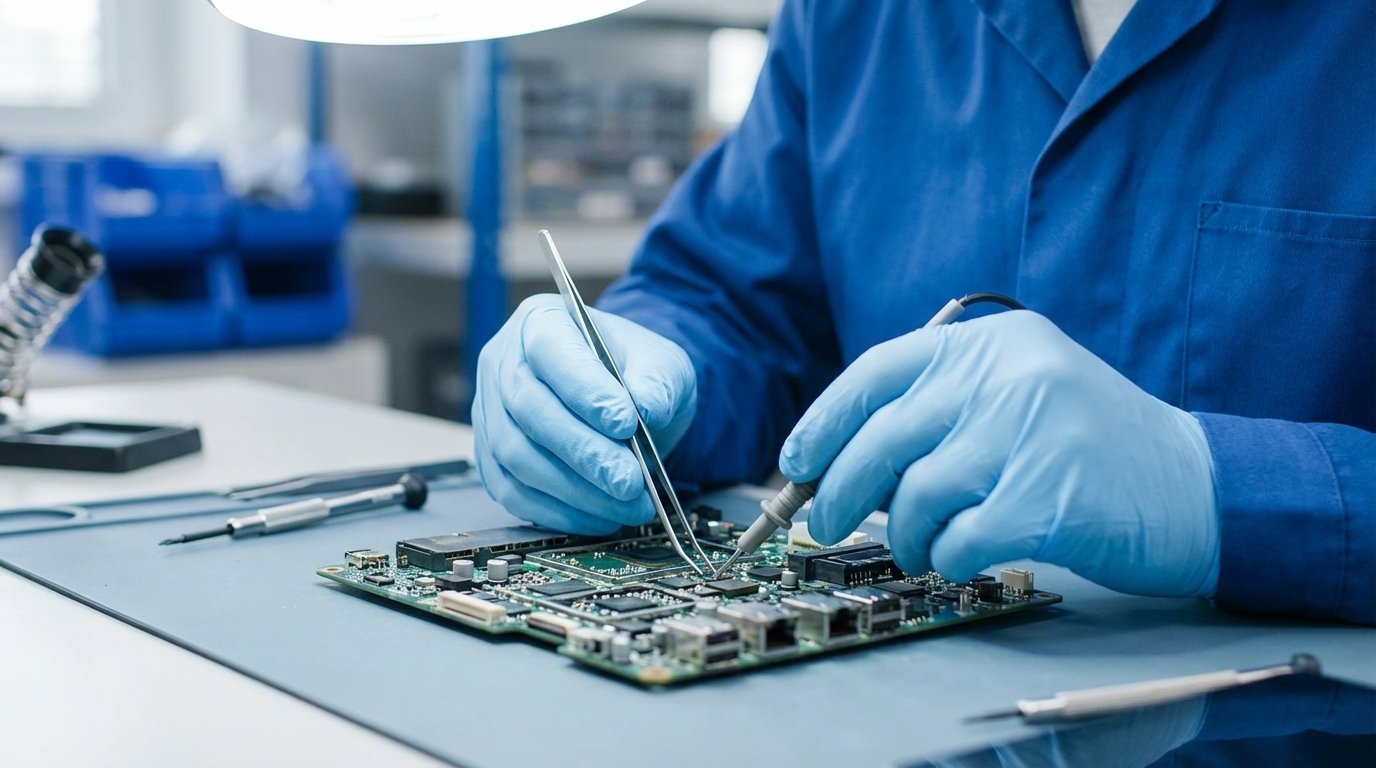
- Depot repair services spanning Level 1–4 diagnostics and RMA processing
- Reverse logistics including refurbishment and grading for secondary markets
- Asset recovery and recycling with secure data destruction
- Visibility and analytics through transportation management systems
IT-specific processes distinguish these services from general PLM software. Examples include SIM pairing for telecom deployments, FERPA-compliant imaging for education, and government-grade secure data wipes. These specialized capabilities enable real-world programs such as telecom warranty processing for carrier networks and government imaging initiatives that require TAA compliance. Talk to a lifecycle expert to understand how IT PLM services address your specific operational requirements.
The 5 Key Stages of Product Lifecycle Management in IT
These IT-specific processes unfold across five critical stages that form the complete lifecycle journey for technology assets.
- Sourcing and Procurement: TAA-compliant product sourcing supports government and enterprise requirements, while vendor consolidation reduces supply chain complexity.
- Deployment, Configuration, and Fulfillment: Services include device imaging, BIOS configuration, custom asset tagging, serialization, and kitting for direct distribution to end users or deployment sites.
- Maintenance and Support: Ongoing repair services, warranty management, rapid exchange programs, and parts reclamation maintain asset availability and extend useful life.
- End-of-Life and Reverse Logistics: RMA intake, triage, refurbishment, and grading enable asset recovery while managing return volumes efficiently.
- Disposition and Recycling: Secure data destruction, responsible recycling, and ITAD compliance support environmental and regulatory requirements while preserving residual value.
Each stage relies on specialized IT asset handling, from initial procurement through final disposition. Digital thread visibility connects these processes to provide end-to-end lifecycle tracking.
Benefits and ROI of IT PLM Services for Enterprises and OEMs
Comprehensive IT product lifecycle management services create measurable operational and financial gains for enterprises and OEMs.
- Cost Reduction: Premier Logitech maquiladora clients achieve over $400 million in supply chain savings and $70 million in raw material savings through refined refurbishment and reuse programs.
- Operational Efficiency: Scalable operations support more than 40,000 repairs per week and 500,000 units per month in kitting capacity, which stabilizes service levels during demand spikes.
- Compliance Assurance: TAA, ISO 9001/14001, NIST, CMMC, and SOC 2 certifications help organizations meet strict regulatory and security requirements.
- Sustainability Impact: Circular lifecycle programs recover value from original equipment through refurbishment and responsible recycling, reducing landfill waste.
- Scalability: Modular services adapt to enterprise needs, from targeted repair or imaging projects to fully integrated lifecycle programs.
ROI examples show notable total cost of ownership reductions when organizations replace fragmented vendor relationships with a single, comprehensive lifecycle partner.
IT Product Lifecycle Management Services Costs and Benchmarks
Clear cost structures help organizations compare IT PLM service investments and understand where integrated programs create savings. The table below highlights how Premier Logitech’s approach compares to typical market pricing across core service categories.
| Service | Typical Cost | Factors | Premier Logitech Benchmark |
|---|---|---|---|
| Consulting | Varies by expertise and requirements | Expertise/CMMC requirements | Included in programs |
| Implementation | Varies by complexity and volume | Complexity/volume | $70M raw savings via refurbishment |
| Reverse Logistics/Repair | Varies by volume and requirements | Volume/ITAD requirements | TCO improvements aligned with the reductions noted above |
Cost savings emerge through volume consolidation, standardized processes, and integrated service delivery models that replace fragmented vendor networks.
Top IT PLM Services Providers Comparison (2026)
Provider selection depends on service scope, compliance depth, and proven performance. The comparison below highlights which vendors deliver end-to-end lifecycle coverage and which focus on narrower, point solutions.
| Provider | Services Scope | Compliance/Scale | Proven Savings/Metrics |
|---|---|---|---|
| Premier Logitech | End-to-end (sourcing to recycling) | TAA/CMMC/SOC 2, 40k repairs per week, 500k kitting per month, 20+ OEM ASCs, CAGE 4WAJ9 | $400M supply chain savings, $70M materials savings |
| Ingram Micro | Partial (fulfillment and logistics) | ISO, global scale | Limited IT-specific metrics |
| CDTI | Reverse logistics focus | NIST, mid-scale | Variable, no end-to-end coverage |
| Encompass | Repair and RMA | Basic, repair-focused | No full lifecycle support |
| Flex | Manufacturing and assembly | ISO, high volume | Fragmented, less IT compliance |
Premier Logitech stands out through integrated services, government-trusted compliance since 2007, and modular programs that support both full lifecycle management and standalone services.
Premier Logitech: Integrated IT Lifecycle Partner
Premier Logitech delivers IT product lifecycle management services through tightly connected capabilities that span sourcing, configuration, transportation, repair, and recycling. Key differentiators include more than 20 OEM Authorized Service Center designations, relationships with over 120 premier LTL carriers, and Transportation Management System integration that provides real-time shipment visibility.
Operational metrics confirm scale and reliability. The company processes more than 40,000 repairs each week, kits 500,000 units per month, and has documented client savings that exceed $400 million in supply chain improvements. Government and enterprise clients benefit from TAA compliance, CAGE Code 4WAJ9, and certifications such as NIST, CMMC, SOC 2, and ISO standards.
Service examples include telecom SLA management for carrier networks, government deployment programs that require secure imaging, and OEM warranty processing across multiple product lines. Organizations evaluating these capabilities often raise concerns about scalability, compliance depth, and vendor consolidation. Premier Logitech addresses these concerns through nearshore operations in Mexico, comprehensive certifications, and single-source lifecycle management that replaces fragmented 3PL relationships.
Organizations ready to explore these capabilities can work with Premier Logitech to design a customized IT lifecycle program.
2026 Trends in IT PLM Services
Several emerging trends are reshaping how IT product lifecycle management services are delivered. Modern PLM platforms that replace manual workflows with unified data environments, automated change management, and AI-enabled design assistance achieve 30–50% reductions in time to market, 25–35% improvements in engineering productivity, and 40–50% faster quality document cycles.
Beyond technology platforms, operational strategies are also evolving. Nearshore operations expansion strengthens supply chain resilience, while circular economy initiatives support sustainable asset recovery and reuse programs.
IoT device growth creates new demand for specialized configuration, monitoring, and support services across large distributed fleets. Updated CMMC requirements raise the bar for cybersecurity and compliance among government contractors and their suppliers.
Premier Logitech responds to these trends through Transportation Management System enhancements, AI-driven analytics integration, and ongoing certification maintenance that keeps pace with changing regulatory expectations.
Frequently Asked Questions
What stages does IT PLM cover?
IT product lifecycle management covers five stages. These stages include sourcing and procurement with trade compliance, deployment and configuration with imaging and kitting, maintenance and support through repair services, end-of-life and reverse logistics for asset recovery, and disposition and recycling with secure data destruction. Each stage addresses IT-specific needs such as data security, compliance frameworks, and specialized hardware handling.
What are PLM services vs. PLM software?
PLM services focus on physical hardware execution, including repair, refurbishment, IT asset disposition, and logistics management. PLM software refers to design and development platforms such as SAP or PTC that support product design and engineering. Services manage operational aspects of technology asset management from deployment through disposition, while software manages the design and development lifecycle.
How much does PLM typically cost?
IT PLM service costs vary based on service type, complexity, and volume. Many organizations reduce total cost of ownership when they consolidate fragmented vendors into a single, comprehensive lifecycle program.
What compliance standards does Premier Logitech meet?
Premier Logitech maintains TAA compliance for government procurement, NIST and CMMC certifications for cybersecurity, SOC 2 for data security, and ISO 9001/14001 for quality and environmental management. The company also holds CAGE Code 4WAJ9, which identifies it as a pre-vetted, high-security partner for U.S. Federal Government contracts.
What are reverse logistics services examples?
Reverse logistics services include RMA intake and processing, depot repair from Level 1–4 diagnostics, rapid exchange programs for telecom carriers, refurbishment and grading for secondary market resale, warranty claim management, and parts reclamation. These services support asset recovery while managing high return volumes efficiently across multiple product lines and customer segments.
How should organizations choose a PLM provider?
Organizations should select providers that offer end-to-end service integration, strong compliance certifications, demonstrated scale, and industry-specific expertise. Evaluation criteria include service scope from sourcing through recycling, compliance capabilities such as TAA and CMMC, operational scale such as repair capacity and carrier relationships, and documented client savings from lifecycle programs.
What are typical PLM metrics?
Key performance indicators include repair capacity measured in units per week, kitting throughput in units per month, total cost of ownership reduction percentages, client savings in dollar amounts, turnaround times for repair and exchange services, first-pass repair yields, asset recovery rates, and compliance audit results. Premier Logitech demonstrates more than 40,000 repairs weekly and significant TCO improvements across client programs.
Conclusion
IT product lifecycle management services close critical operational gaps for enterprises, OEMs, telecoms, and government agencies by coordinating asset management from sourcing through recycling. Premier Logitech delivers proven, compliant, end-to-end solutions backed by operational scale, government certifications, and documented client results. Schedule a consultation to develop your scalable IT product lifecycle management services program.
