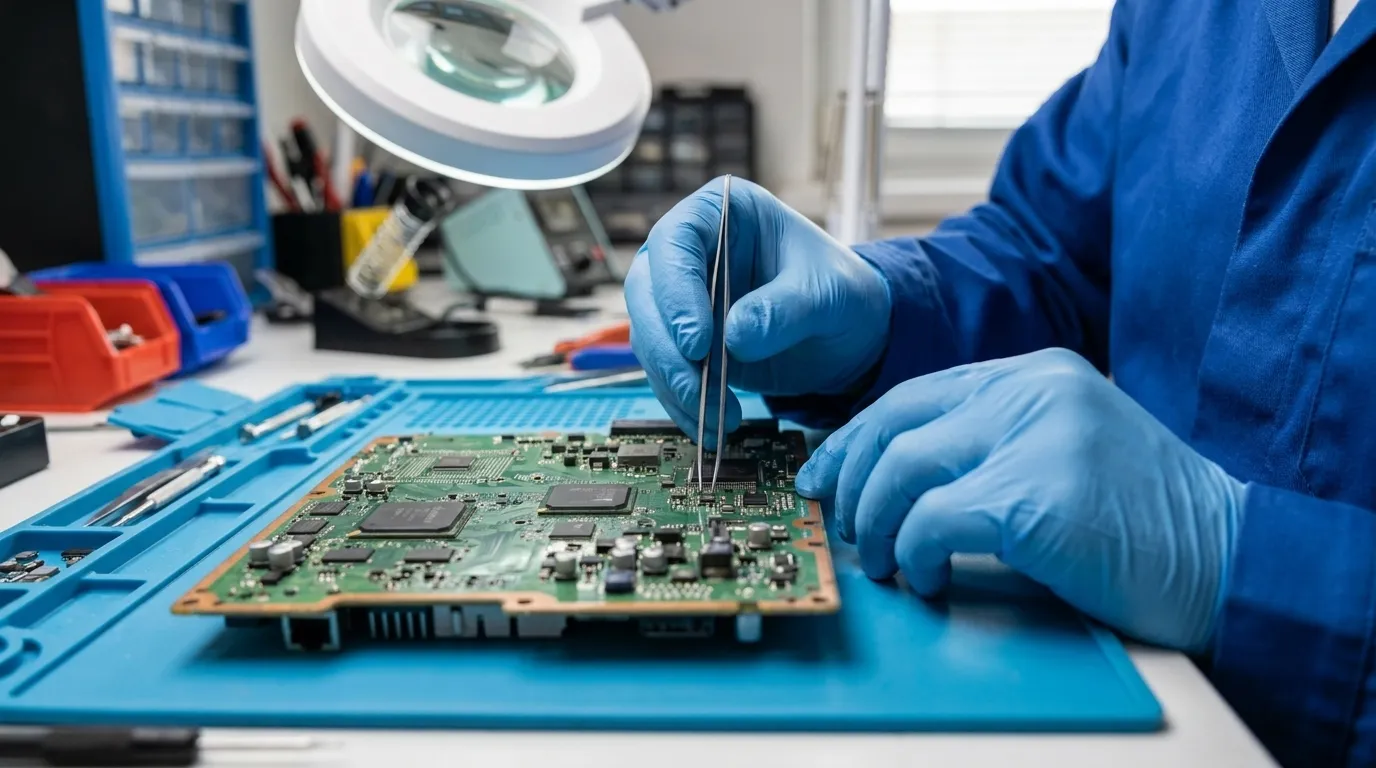
Device lifecycle compliance in 2026 spans procurement, cybersecurity, data protection and environmental rules that converge on the same hardware. Enterprise and public sector programs must now prove compliance at every phase, from planning through certified recycling, under closer audit scrutiny and tighter federal expectations.
Key Takeaways
- Device lifecycle compliance standards in 2026 cover procurement integrity, cybersecurity controls, data sanitization and certified e-waste disposal across enterprise and government environments.
- Organizations must align sourcing, configuration, asset tracking, maintenance and disposal activities with overlapping requirements from TAA, CMMC, NIST and ISO/IEC frameworks.
- Each of the eight lifecycle phases, from planning through disposal, carries specific compliance obligations that require documented evidence and certified processes.
- Premier Logitech delivers end-to-end operational support, including TAA-compliant sourcing, ASC-authorized repair, NIST SP 800-88 Rev. 2 data destruction and certified recycling under a single program.
- Map the current device lifecycle program against 2026 compliance requirements and identify gaps at scale.
Eight-Phase Device Lifecycle and Compliance Actions
- Planning and Requirements. Define compliance obligations such as TAA, CMMC level and NIST control baselines before procurement begins. Premier Logitech lifecycle advisory aligns sourcing strategy to contractual and regulatory requirements from day one.
- Procurement and Sourcing. Acquire devices from TAA-designated country manufacturers and verify supply chain provenance per NIST SP 800-53 Rev. 5 Supply Chain Risk Management controls. Premier Logitech provides trade-compliant sourcing through vendor-consolidated, open-market and channel distribution channels.
- Configuration and Deployment. Apply security baselines, imaging, BIOS configuration and software loads before devices reach end users, consistent with NIST SP 800-171 Rev. 3 configuration management requirements. Premier Logitech handles SIM and IMEI pairing, modern cloud-based provisioning and serialized asset tagging at scale.
- Asset Management and Tracking. Maintain continuous inventory visibility and device traceability to satisfy audit and authorization requirements under NIST SP 800-53 Rev. 5 and ISO/IEC/IEEE 15288:2023. Premier Logitech delivers real-time tracking and lifecycle analytics through its Transportation Management System and warehouse operations.
- Operation and Maintenance. Perform authorized repair and preventive maintenance to sustain device security posture, consistent with NIST SP 1800-36 guidance on verifying device posture before permitting operations. Premier Logitech holds ASC authorization for more than 20 OEM brands and performs L1–L4 depot repair.
- Return and Refurbishment. Process returns through documented RMA intake, triage, grading and cosmetic refurbishment to extend asset value and reduce e-waste, supporting WEEE collection obligations. Premier Logitech reverse logistics operations provide scalable RMA management and certified refurbishment for secondary market channels.
- Data Sanitization. Apply Clear, Purge or Destroy methods per NIST SP 800-88 Rev. 2 before any device changes custody or is retired. Premier Logitech performs certified secure data destruction with documented reporting for audit evidence.
- Disposal and Recycling. Dispose of end-of-life devices through certified recycling programs that satisfy RoHS hazardous substance restrictions and WEEE reporting obligations. Premier Logitech responsible recycling and e-waste reduction programs provide compliant disposition with full chain-of-custody documentation.
Map the device program to the eight compliance phases with a lifecycle expert.
Enterprise and Government Compliance Requirements
The eight lifecycle phases apply across device programs, and federal work adds TAA, CMMC and NIST frameworks that cut across multiple phases. U.S. government contractors and enterprise suppliers face overlapping obligations from these standards that must be satisfied simultaneously across the device lifecycle.
TAA requires that products procured under U.S. government contracts be manufactured or substantially transformed in TAA-designated countries. Non-compliant sourcing creates contract risk and potential debarment, which drives the need for sourcing partners with established federal credentials. Premier Logitech maintains CAGE Code 4WAJ9, identifying it as a pre-vetted partner for federal procurement, and sources through trade-compliant channels that satisfy TAA requirements at the line-item level.
CMMC 2.0 maps directly to NIST SP 800-171 Rev. 3, which was published in May 2024 and organizes CUI protection requirements across 14 control families. Defense contractors handling CUI must demonstrate compliance with these controls across every system that processes, stores or transmits that information, including the devices themselves. Premier Logitech supports CMMC-aligned programs through ISO-certified operations, SOC 2 compliance and documented compliance reporting.
NIST SP 800-53 Rev. 5 provides the broader control catalog for federal information systems, covering 20 families with technology-neutral, outcome-based controls. Its Supply Chain Risk Management and System and Services Acquisition families directly govern how devices are sourced, configured and maintained. Premier Logitech end-to-end program management provides the operational infrastructure to implement and evidence these controls.
Cybersecurity Standards Across the Lifecycle
NIST frameworks define federal expectations, and broader cybersecurity standards extend those expectations to device fleets in any sector. Cybersecurity obligations attach to devices at every lifecycle phase, not only at disposal. ISO/IEC 27001 and ISO/IEC 27402 establish information security management and IoT-specific baseline controls that apply from onboarding through decommissioning. NIST SP 1800-36, published in final form in November 2025, provides implementation guidance for trusted IoT device network-layer onboarding, including attestation of device identity and posture verification before issuing network credentials.
At end of life, NIST SP 800-88 Rev. 2, published in September 2025, defines media sanitization expectations for modern storage. The appropriate method depends on data sensitivity and the intended disposition of the media. Premier Logitech performs certified data destruction aligned to SP 800-88 Rev. 2 and provides destruction certificates and chain-of-custody reports as audit evidence.
Environmental Disposal and E-Waste Standards
RoHS restricts the use of lead, mercury, cadmium, hexavalent chromium and other hazardous substances in electrical and electronic equipment. Compliance begins at procurement, with specification of RoHS-compliant components, and continues through disposal, where hazardous materials must be handled by certified recyclers. WEEE establishes collection, treatment and reporting obligations for waste electrical and electronic equipment, requiring organizations to document disposition and meet recycling rate targets.
Premier Logitech responsible recycling and e-waste reduction programs provide certified disposition for end-of-life devices, with documentation that supports RoHS and WEEE compliance reporting. Parts reclamation and harvesting extend component value before final recycling, which reduces total e-waste volume.
Frequently Asked Questions
What is the difference between NIST SP 800-53 and NIST SP 800-171 for device lifecycle compliance?
NIST SP 800-53 Rev. 5 is the comprehensive security and privacy control catalog for federal information systems, covering 20 control families and used within the Risk Management Framework. NIST SP 800-171 Rev. 3 is a subset framework derived from SP 800-53 that applies specifically to nonfederal organizations handling Controlled Unclassified Information. For device lifecycle compliance, SP 800-53 governs federal agency systems directly, while SP 800-171 governs the enterprise and contractor systems that interact with federal data, including the devices those organizations procure, operate and retire.
When did NIST SP 800-88 Rev. 2 take effect and what changed from Rev. 1?
NIST SP 800-88 Rev. 2 was published on Sept. 26, 2025, superseding Rev. 1 from December 2014. The revision updates sanitization guidance to reflect current storage technologies, media types and threat models. Organizations that built data destruction programs around Rev. 1 should review their procedures and documentation against the Rev. 2 requirements, particularly for modern flash-based and cloud-connected storage media.
What does TAA compliance require for IT hardware procurement?
The Trade Agreements Act requires that products acquired under U.S. government contracts be manufactured or substantially transformed in a TAA-designated country. For IT hardware, this means verifying country-of-origin documentation from suppliers and maintaining those records as contract evidence. Non-compliant products, even those that meet all technical specifications, can trigger contract violations. Organizations benefit from a sourcing partner that maintains established TAA-compliant supply channels and can provide documentation at the line-item level.
How does CMMC 2.0 relate to device lifecycle management?
CMMC 2.0 establishes tiered cybersecurity maturity requirements for Department of Defense contractors. As noted earlier, its controls map directly to NIST SP 800-171 Rev. 3, which covers media protection, physical security, configuration management and supply chain risk that apply to physical devices throughout their lifecycle. A device that is improperly configured at deployment, inadequately tracked during operation or insufficiently sanitized at disposal can create a CMMC gap that affects contract eligibility. Lifecycle compliance and CMMC compliance operate on the same device estate and reinforce each other.
What evidence is required to demonstrate NIST SP 800-88 Rev. 2 compliance at disposal?
Organizations must document the sanitization method applied to each media type, the tool or process used, the date of sanitization and the identity of the personnel or vendor performing the work. For destruction, a certificate of destruction with serial number-level detail and chain-of-custody records are standard audit artifacts. Third-party vendors performing sanitization on behalf of an organization should provide these records as a defined deliverable.
Next Steps: Operationalize Device Lifecycle Compliance
Managing device lifecycle compliance across ISO/IEC, NIST, CMMC, TAA and environmental standards requires operational infrastructure, not only policy documentation. Premier Logitech provides the certifications, authorizations and execution capacity to satisfy each requirement, from TAA-compliant sourcing and ASC-authorized repair to NIST SP 800-88 Rev. 2-aligned data destruction and certified recycling, under a single program.
Talk to a lifecycle expert to schedule a consultation and build a compliance-ready lifecycle program for the organization.
