Key Takeaways
-
Device lifecycle management spans planning through disposal, and fragmented vendor relationships create accountability gaps, compliance risks and lost recovery value.
-
Premier Logitech delivers authorized OEM repair, TAA and CMMC compliance and end-to-end lifecycle services from a single partnership, eliminating multi-vendor complexity.
-
Organizations gain real-time visibility, scalable logistics and higher asset recovery value by consolidating to one lifecycle partner instead of managing multiple providers.
-
Government and regulated-industry programs benefit from Premier Logitech’s CAGE Code, NIST, SOC 2 and federal compliance certifications that most vendors lack.
-
Talk to a lifecycle expert at Premier Logitech to map the current vendor footprint and build a consolidated program that reduces cost and risk.
Service Scope Across the Full Device Lifecycle
Service scope defines which lifecycle stages a vendor can support. Leading providers typically cover some combination of sourcing, deployment, repair and disposition. Few cover all four with equal depth.
Most 3PLs focus on warehousing and transportation. Most IT asset disposition firms specialize in end-of-life processing. Specialized reverse logistics providers, such as ModusLink, concentrate on returns, refurbishment and resale loops within specific verticals. OEM service networks limit repair authorization to their own branded hardware.
This specialization forces many programs to manage separate vendors for forward logistics, repair and disposition. Each handoff introduces coordination effort, fragmented data and unclear ownership when devices move between providers.
The gap most programs encounter is authorized repair coverage across multiple OEM brands combined with end-to-end program management. Premier Logitech operates as both a single-source lifecycle partner and a modular services provider. Organizations can engage the full program, from sourcing and configuration through reverse logistics and recycling, or select individual services such as depot repair, kitting or transportation on a standalone basis.
Technical Capabilities for Enterprise-Grade Repair and Configuration
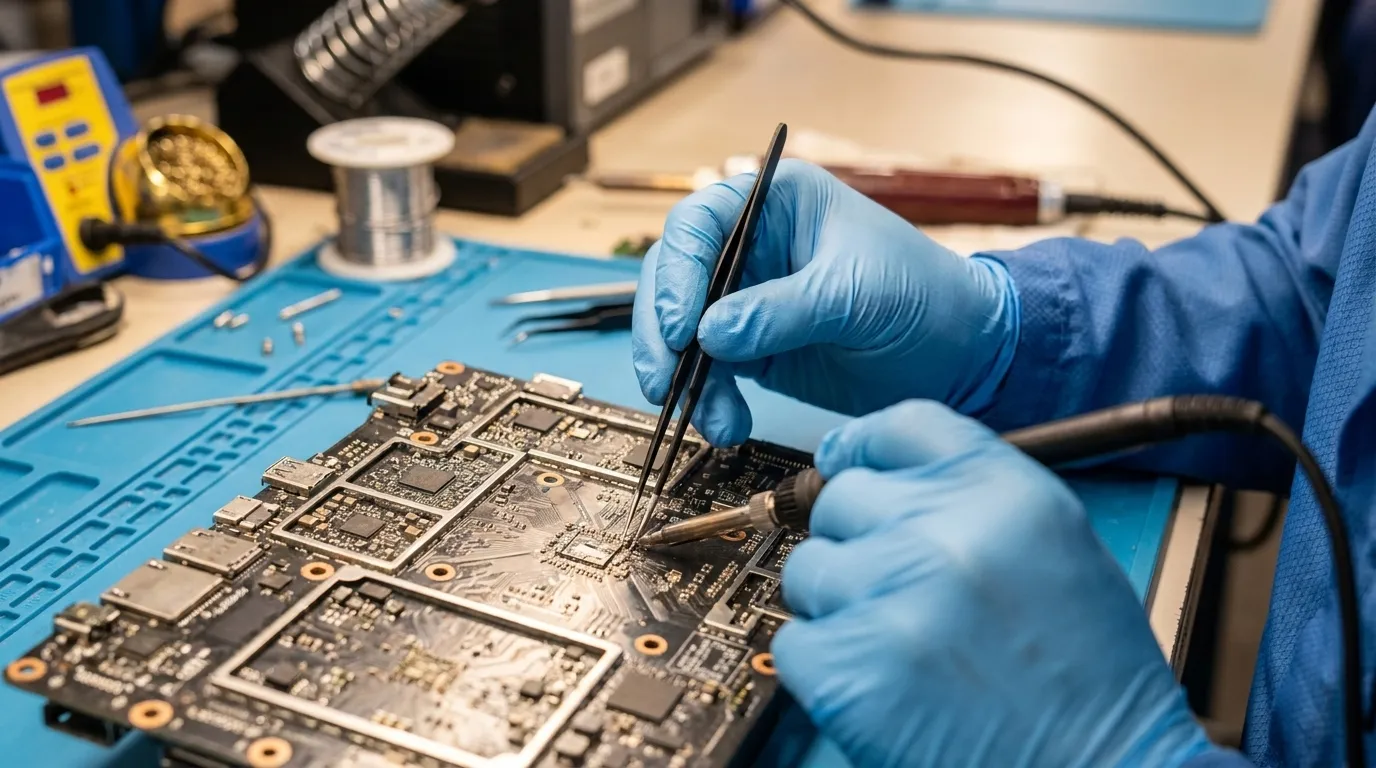
Technical depth determines how well a vendor delivers the services in its scope. Repair depth varies significantly across vendor categories. Many providers offer cosmetic refurbishment or basic triage. Fewer maintain OEM-authorized service center status, which is required for warranty-valid L1 through L4 repairs across multiple brands.
Deferred maintenance commonly drives unplanned hardware replacement costs. Programs without an authorized repair partner absorb those costs at full replacement price. Premier Logitech holds authorization across multiple OEM Authorized Service Centers, which allows the company to process warranty-valid repairs at enterprise volume.
That authorization connects directly to configuration and kitting. Premier Logitech moves devices from repair or initial receipt to deployment-ready status through imaging, BIOS configuration, SIM and IMEI pairing, software installation and BOM-based kitting at scale. This integrated flow removes the need for a separate configuration vendor and reduces turnaround time between repair, staging and redeployment.
Quality and Compliance for Regulated Environments
Quality and security frameworks set the baseline for trust in a lifecycle partner. Standard certifications such as ISO 9001 form a starting point. Government and regulated-industry programs require more specific controls.
These programs often mandate TAA compliance under FAR Subpart 25.4, CMMC alignment for defense supply chain participation, NIST Cybersecurity Framework adherence as defined in NIST CSF 2.0 and certified data destruction that meets federal standards. Each requirement adds another layer of documentation, process control and audit readiness.
Many vendors carry one or two of these certifications. Gaps in TAA coverage or data destruction protocols create direct compliance exposure. The global average cost of a data breach reached $4.4 million in 2025. A compliant lifecycle program reduces the likelihood and impact of such incidents.
Premier Logitech maintains TAA, TAPA, ISO quality frameworks, NIST, CMMC and SOC 2 certifications. The company holds CAGE Code 4WAJ9, which identifies it as a pre-vetted partner for U.S. federal government programs.
Scalability and Flexibility During Volume Spikes
Compliance establishes baseline trust. Scalability shows whether a vendor can maintain that standard when demand surges. Volume spikes driven by device refresh cycles, new hire waves or product recalls expose the limits of providers built for steady-state operations.
Organizations without structured lifecycle programs routinely pay more per unit on emergency replacements than those operating on planned schedules. Vendors that lack scalable facilities or flexible engagement models often respond with longer lead times and premium pricing.
Premier Logitech operates multiple DFW facilities with nearshore operations in Laredo and Nuevo Laredo, Mexico. This hub structure supports high-volume throughput while maintaining cost efficiency, which allows the company to absorb volume spikes without degrading turnaround times. The modular model described earlier means clients can access that scalable capacity for specific services without committing to a full-program contract.
Visibility and Data Across the Device Lifecycle
Data visibility determines how effectively leaders manage device fleets and risk. Multi-vendor environments fragment data. Each provider tracks its own slice of the lifecycle, which leaves operations and supply chain leaders without a consolidated view of asset status, repair history or recovery value.
A 2023 Forrester study found that lost and stolen devices accounted for 17% of all data breaches, a risk that centralized asset tracking directly reduces. Premier Logitech Transportation Management System, real-time tracking infrastructure and lifecycle analytics provide single-source visibility across inventory, repair status and asset disposition. This unified view replaces the patchwork reporting that multi-vendor programs produce.
Talk to a lifecycle expert about consolidating vendor reporting into one operational view.
Network and Logistics Coverage for Distributed Operations
Logistics coverage determines whether a lifecycle program can execute consistently across regions. Geographic reach and carrier depth influence transit times, cost and reliability. Many providers rely on a limited carrier base or lack cross-border capabilities, which creates bottlenecks for programs with distributed U.S. operations or nearshore supply chain activity.
Premier Logitech maintains a broad logistics network that spans multiple North American LTL carriers. Services include full and partial truckload, intermodal, international air and ocean, white glove delivery and courier services, all managed through a proprietary TMS. Cross-border capabilities through the Laredo corridor support programs with U.S.-Mexico supply chain requirements.
Total Cost and Asset Recovery Value
Total cost in lifecycle programs extends beyond unit pricing. Fragmented models erode asset recovery value at every handoff. Each additional vendor introduces margin, handling fees and processing delays that reduce what organizations recover from returned or end-of-life devices.
Recycling one million cell phones recovers tens of thousands of pounds of copper along with silver, gold and palladium, materials with real secondary market value that fragmented programs often lose to write-offs or low-recovery channels. Premier Logitech asset recovery, remarketing and certified refurbishment programs capture that value by keeping devices within a single processing chain rather than distributing them across providers with competing margin structures. Beyond material recovery, vendor consolidation into one partner eliminates redundant fees and reduces the administrative overhead of managing multiple contracts, SLAs and escalation paths.
Government and Regulated-Industry Requirements
Government and regulated-industry programs operate under procurement and security mandates that exceed typical commercial requirements. TAA compliance governs product sourcing under FAR Subpart 25.4, which requires that end products originate from the U.S. or designated countries. CMMC establishes cybersecurity maturity requirements for defense contractors. NIST frameworks define security controls for federal information systems. Data destruction must meet documented standards that withstand audit review.
Environmental regulations add further complexity. 40 CFR Part 273 establishes federal management standards for batteries and mercury-containing equipment commonly generated during device disposition. Lifecycle vendors handling government assets must align operational processes, documentation and training with these rules.
The compliance posture described earlier, spanning TAA, CMMC, NIST and SOC 2, maps directly to these requirements. Government and regulated-industry buyers can work with a vendor that has already cleared the compliance baseline rather than building it from scratch.
Enterprise Reverse Logistics Depth
Reverse logistics often determines how much value a lifecycle program recovers. RMA intake, triage, grading, refurbishment and rapid exchange require both operational scale and OEM authorization. Without authorization, repairs can void warranties. Without scale, turnaround times extend and exchange programs stall.
The reverse logistics market is valued at a significant level in 2025 and is projected to grow at a steady rate through 2034, driven by e-commerce returns, sustainability commitments and extended producer responsibility frameworks. Enterprise programs that treat reverse logistics as an afterthought leave significant recovery value on the table.
Premier Logitech reverse logistics capabilities include RMA management, L1 through L4 depot repair, sorting and grading, cosmetic refurbishment, in-warranty and out-of-warranty claim support, rapid exchange, secure data destruction and responsible recycling, all backed by multiple OEM ASC authorizations.
Conclusion: Selecting a Consolidated Device Lifecycle Partner
Evaluating device lifecycle vendors across seven dimensions, including service scope, technical capabilities, quality and compliance, scalability, visibility, logistics coverage and total cost, reveals a consistent pattern. Most providers excel in one or two areas and create gaps in the rest.
Enterprise, OEM and government programs benefit from a partner that closes all seven gaps without requiring multiple contracts, multiple escalation paths or multiple compliance reviews. Premier Logitech delivers authorized OEM repair, government-grade compliance, end-to-end service scope and the logistics infrastructure to execute at scale through a single partnership.
Talk to a lifecycle expert and build a consolidated lifecycle program aligned with specific operational requirements.
Frequently Asked Questions
What is the difference between device lifecycle management and reverse logistics?
Device lifecycle management covers the full arc of a technology asset, from planning and procurement through deployment, maintenance and end-of-life disposition. Reverse logistics is a subset of that arc focused on the return flow, including RMA intake, triage, repair, refurbishment, grading and recycling. Some vendors specialize in one or the other. Premier Logitech delivers both as part of a single integrated program, which eliminates the handoff gaps that occur when forward and reverse logistics are managed by separate providers.
How does TAA compliance affect device lifecycle vendor selection for government programs?
The Trade Agreements Act governs product sourcing in covered federal acquisitions and requires that end products originate from the U.S. or a designated country. For lifecycle programs, this requirement affects initial procurement, refurbishment parts sourcing, redeployment decisions and the origin of repair services. Vendors without verified TAA compliance create procurement risk for government buyers. Premier Logitech maintains TAA compliance and holds CAGE Code 4WAJ9, which identifies the company as a pre-vetted partner for U.S. federal government programs.
What should enterprise buyers look for in an OEM-authorized repair network?
OEM Authorized Service Center status means a vendor has been certified by the manufacturer to perform warranty-valid repairs at specific levels, from basic diagnostics and component replacement to board-level repair. Without ASC authorization, repairs can void warranties and create liability for enterprise programs managing large device fleets. Buyers should evaluate the number of OEM brands covered, the repair levels authorized for each and the weekly throughput capacity of the depot. Premier Logitech holds authorization across more than 20 OEM brands and operates at a repair volume that supports enterprise-scale programs.
How does vendor consolidation reduce total cost of ownership in device lifecycle programs?
Fragmented vendor relationships introduce costs at every handoff, including redundant handling fees, separate SLA management, inconsistent data formats and gaps in asset recovery value. Each additional vendor also adds compliance review burden, particularly for government and regulated-industry programs. Consolidating to a single lifecycle partner reduces administrative overhead, improves asset traceability and captures more recovery value by keeping refurbishment and remarketing within one program rather than distributing it across providers with competing margin structures.
Can Premier Logitech support programs that only need specific lifecycle services rather than a full end-to-end program?
Premier Logitech operates as both a single-source lifecycle partner and a modular services provider. Organizations can engage the company for a complete end-to-end program spanning sourcing, configuration, fulfillment, repair and disposition, or they can select individual services such as depot repair, transportation or kitting on a standalone basis. This modular model allows programs to consolidate specific functions without restructuring the entire vendor ecosystem and to expand the engagement as operational needs evolve.
