Key Takeaways for Enterprise Warranty Repair
- Enterprise warranty repair IT services connect intake, triage, authorized depot repair, grading, redeployment and compliant disposal to protect value and chain-of-custody.
- Effective partner selection uses six criteria: service scope, technical capabilities, certifications, scalability, visibility and total cost of ownership.
- Only OEM-authorized service centers perform in-warranty repairs that preserve original warranties and satisfy audit requirements for enterprise and government fleets.
- Triage-first workflows and rapid exchange programs cut replacement costs, protect warranty integrity and support high-volume RMA operations across L1-L4 repair levels.
- Premier Logitech delivers consolidated, compliant warranty repair programs as a single authorized partner; start a program with Premier Logitech.
Six Criteria for Evaluating Warranty Repair Partners
Operations leaders benefit from a clear framework when selecting a warranty repair partner. The following six criteria support consistent evaluation.
- Service scope: The partner covers L1-L4 depot repair, rapid exchange, RMA management, refurbishment and recycling under one program.
- Technical capabilities: The partner holds OEM Authorized Service Center (ASC) status for the brands in the fleet.
- Quality and compliance: Certifications remain current for TAA, NIST SP 800-171, CMMC, SOC 2 and ISO frameworks.
- Scalability: The partner absorbs volume spikes without degrading turnaround or quality.
- Visibility: The partner provides real-time inventory tracking, lifecycle analytics and compliance reporting.
- Total cost of ownership: The program reduces fragmented vendor spend and recovers asset value through refurbishment and remarketing.
A partner that cannot satisfy all six criteria introduces operational, financial or compliance risk into the program. To reduce these risks and build a program that meets all six criteria from the start, start building a compliant, consolidated warranty repair program with Premier Logitech.
OEM Authorization for Enterprise Warranty Repairs
OEMs grant Authorized Service Center status to partners that meet technical training, tooling, parts sourcing and quality standards. ASC-authorized providers perform in-warranty repairs that preserve the original OEM warranty, use genuine parts and satisfy OEM audit requirements.
For enterprises and government agencies with multi-brand fleets, a repair provider without ASC status for a brand cannot perform covered warranty work on that brand’s devices under contract. The authorization process remains brand-specific and requires ongoing compliance with each OEM’s evolving standards.
Premier Logitech holds ASC authorizations across more than 20 OEM brands, covering a broad range of IT hardware categories common in enterprise and government fleets.
Repair Versus Replace Economics for High-Volume IT Assets
The economic case for repair over replacement depends on structured triage that directs each asset to the lowest-cost viable path. Once a provider holds the necessary authorizations, the next decision centers on whether to repair or replace each returned device.
High-volume programs answer this decision through a structured triage and disposition workflow. Returned devices enter intake, where technicians assess functional and cosmetic condition. Assets receive grades against defined criteria such as fully functional, repairable, cosmetically impaired but functional or end-of-life.
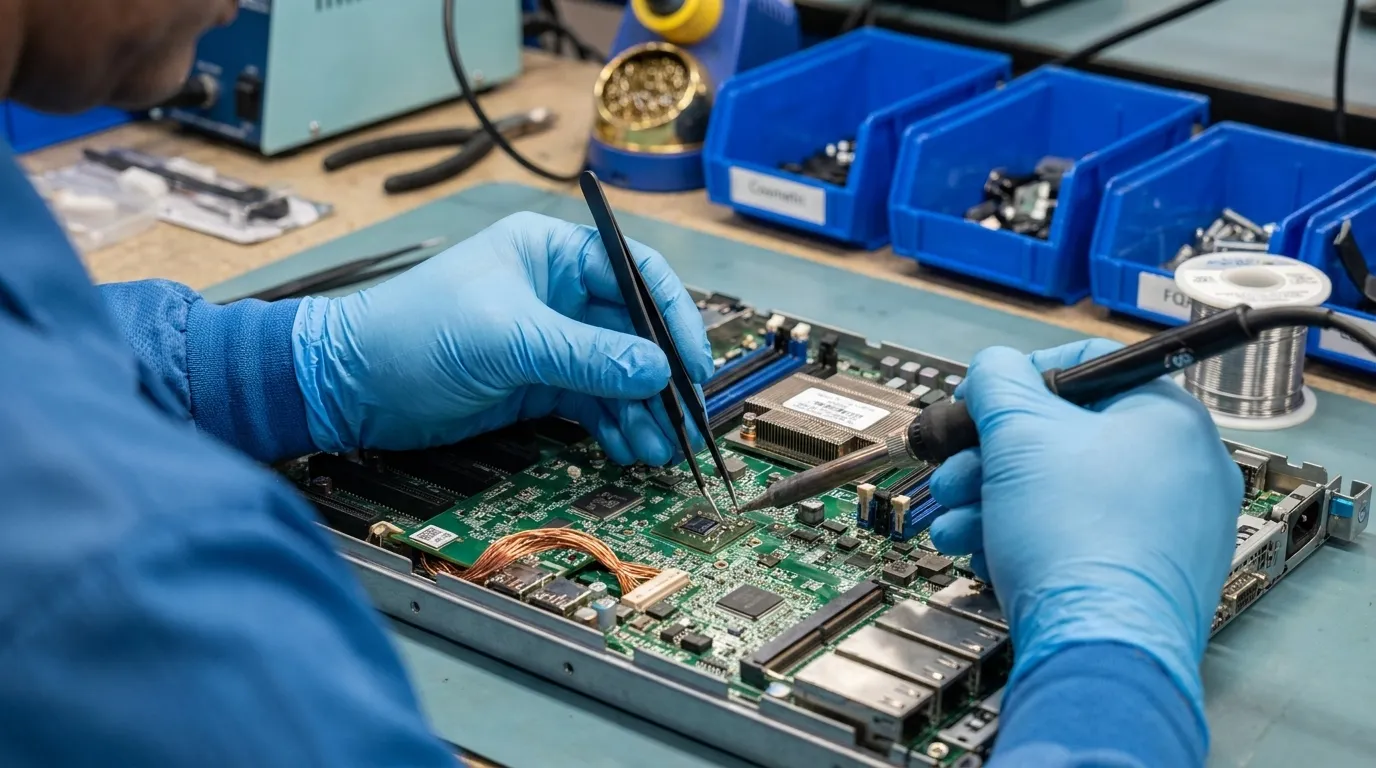
Repairable units move to the appropriate repair level. L1 covers software and configuration. L2 covers component-level board work. L3 covers advanced diagnostics. L4 covers depot-level rebuild. Repaired and refurbished units are regraded, then routed to redeployment, rapid exchange pools or secondary market channels.
Only assets that cannot be economically restored move to responsible recycling. This triage-first model recovers asset value at each stage rather than defaulting to replacement. The approach reduces capital expenditure and e-waste. Unplanned replacement and emergency procurement represent some of the largest hidden costs in enterprise IT, so structured repair workflows act as a direct lever for cost control.
Compliance Requirements for Government and Regulated OEM Programs
Government and regulated enterprise programs impose compliance requirements that consumer repair channels cannot meet. Each framework addresses a distinct risk domain but together they form a unified compliance strategy.
FAR clause 52.225-5 (Trade Agreements Act) requires that end products delivered under applicable federal acquisitions, including repaired or refurbished equipment returned to government customers, qualify as U.S.-made or designated country end products. Qualification depends on the product being manufactured in or substantially transformed in a qualifying country into a new article with a distinct name, character or use.
NIST SP 800-171 establishes 110 security practices for protecting Controlled Unclassified Information in nonfederal systems. Repair and reverse logistics providers handling CUI for Defense Industrial Base contractors must implement access control, configuration management, media protection, audit logging and incident response controls mapped to these practices.
CMMC Level 2, administered under 32 C.F.R. Part 170, requires third-party assessment by a C3PAO for providers handling CUI. Self-attestation does not satisfy Level 2. DFARS clauses 252.204-7012, 7019 and 7020 further require defense contractors to implement NIST SP 800-171 requirements and report assessment scores.
SOC 2 Type II (AICPA) documents operating effectiveness of controls across the Trust Services Criteria for Security, Availability, Processing Integrity, Confidentiality and Privacy over a defined period. Enterprise clients frequently require SOC 2 Type II reports as a contractual condition for engaging IT service providers.
Secure data destruction functions as a non-negotiable control across all regulated programs. Chain-of-custody documentation, certified wipe or physical destruction and compliance reporting must accompany every asset disposition event. These controls connect the frameworks above into a single defensible compliance posture.
High-Volume RMA and Depot Repair Workflows
Compliance requirements shape how high-volume RMA and depot repair workflows operate in practice. Structured workflows reduce cycle time, protect warranty claim integrity and support consistent documentation.
A well-designed program follows this sequence:
- Intake and logging: Devices are received, serialized and logged against RMA records with full chain-of-custody documentation.
- Triage and grading: Technicians assess functional and cosmetic condition, assign a grade and route the asset to the appropriate repair level or disposition path.
- L1-L4 depot repair: OEM-authorized technicians perform repairs using genuine parts, with quality checkpoints at each level.
- Quality verification: Repaired units undergo functional testing and cosmetic inspection before regrading.
- Rapid exchange fulfillment: Exchange pools enable same-day or next-day replacement dispatch while the original unit completes the repair cycle.
- Redeployment or disposition: Verified units return to active inventory, secondary market channels or responsible recycling based on grade and program requirements.
- Compliance reporting: Program-level reporting covers repair volumes, disposition outcomes, data destruction certificates and compliance status.
Map a depot repair workflow to program requirements with Premier Logitech.
Out-of-Warranty Options and Asset Value Recovery
Out-of-warranty assets still carry recoverable value when supported by structured programs. The same L1-L4 depot infrastructure restores devices to functional condition at the client’s cost, often at a fraction of replacement cost.
Cosmetic refurbishment, including screen replacement, chassis repair and battery swap, prepares devices for secondary market grading. Graded refurbished units move to remarketing channels and generate recovery revenue that offsets program costs.
Assets that cannot be economically restored enter responsible recycling and e-waste reduction programs with certified destruction and compliance documentation. The IT asset disposition market is projected to reach $54.54 billion by 2030, reflecting growing enterprise focus on value recovery and sustainable disposal as integrated lifecycle outcomes.
Authorized Service Centers Compared with Retail Repair Options
Retail repair channels serve individual consumers with single-device needs, which creates limits for enterprise programs. Unlike the ASC-authorized providers discussed earlier, retail repair channels operate outside the OEM authorization framework.
This lack of authorization means retail providers cannot process high-volume RMA programs and do not maintain the compliance documentation required by government or regulated enterprise contracts. Retail channels also lack the chain-of-custody controls, secure data destruction capabilities and compliance reporting infrastructure that TAA, NIST, CMMC and SOC 2 programs require.
For organizations managing hundreds or thousands of devices across multiple OEM brands, retail repair introduces warranty voidance risk, compliance exposure and operational bottlenecks. Authorized depot programs address these risks through scale, documentation and OEM alignment.
Consolidating Vendors with a Single Authorized Partner
A typical organization manages security and operational solutions across dozens of different vendors, and IT repair and reverse logistics programs follow the same pattern. Fragmented vendor relationships across repair, fulfillment and recycling providers create visibility gaps, inconsistent compliance postures and compounding administrative overhead.
A single authorized partner that covers the full lifecycle, from RMA intake through depot repair, rapid exchange, refurbishment, remarketing and recycling, eliminates those gaps. Consolidated programs produce unified compliance reporting, single-point accountability and integrated data flows that support lifecycle analytics and cost modeling.
Vendor consolidation also reduces the contract management burden and the risk of compliance gaps that emerge when multiple providers operate under different standards.
Premier Logitech Enterprise Warranty Repair Capabilities
Premier Logitech delivers authorized in-warranty repair across a broad range of enterprise IT hardware categories. Depot repair infrastructure supports L1 through L4 repair at scale, with capacity to process high volumes of devices per week across facilities in the Dallas-Fort Worth area and nearshore operations in Laredo and Nuevo Laredo.
Rapid exchange programs maintain device pools for same-day or next-day replacement fulfillment. Configuration and fulfillment services, including imaging, BIOS configuration, SIM and IMEI pairing and kitting, integrate directly with repair workflows to support deployment-ready returns.
Asset recovery programs cover cosmetic refurbishment, grading, remarketing and responsible recycling with certified data destruction. Compliance certifications include TAA, NIST, CMMC, SOC 2, ISO 9001/14001 and TAPA, with a CAGE Code (4WAJ9) that establishes Premier Logitech as a pre-vetted federal government partner.
These capabilities support both single-source lifecycle engagements and modular service arrangements, so clients can align scope with operational need.
Internal Readiness Checklist and Next Steps
Operations leaders gain better outcomes when internal readiness work precedes partner engagement. The following factors support a smooth transition to a consolidated program.
- Current OEM brand inventory is documented and repair authorization requirements are identified for each brand.
- Compliance requirements for TAA, NIST, CMMC, SOC 2 and ISO are defined for the program and mapped to vendor qualification criteria.
- RMA volume, average repair cycle expectations and rapid exchange requirements are quantified.
- Data destruction and chain-of-custody documentation requirements are specified for all asset disposition paths.
- Existing vendor relationships across repair, fulfillment and recycling are mapped and consolidation opportunities are identified.
- Lifecycle analytics and compliance reporting requirements are defined for program governance.
Organizations that can confirm these factors are positioned to engage a consolidated authorized partner and begin program design. Begin a program assessment with Premier Logitech.
Frequently Asked Questions
What is the difference between an Authorized Service Center and a general repair provider for enterprise IT?
An Authorized Service Center holds a formal authorization from an OEM to perform in-warranty repairs using genuine parts and OEM-approved processes. General repair providers lack this authorization, so repairs they perform may void the original warranty and do not meet OEM audit standards. For enterprise programs managing multi-brand fleets, ASC status functions as a prerequisite for compliant in-warranty work.
Which compliance frameworks apply to IT warranty repair providers serving federal government clients?
Federal government programs typically require the compliance frameworks detailed in the Compliance Requirements section above. These include TAA for product origin, NIST SP 800-171 for CUI handling, CMMC Level 2 for Defense Industrial Base work and SOC 2 for operational controls. Specific requirements depend on contract type and the sensitivity of the data involved.
How does a rapid exchange program work within a depot repair workflow?
A rapid exchange program maintains a pool of pre-tested, deployment-ready devices that can be dispatched to replace a failed unit while the original device completes the repair cycle. The failed device enters the standard RMA and depot repair workflow of intake, triage, repair, testing and regrading, then returns to the exchange pool or redeployment inventory upon completion. This model decouples end-user downtime from repair cycle time, which supports service level requirements on device availability.
What happens to IT assets that cannot be repaired under warranty?
Assets that fail triage or exceed economic repair thresholds are routed to out-of-warranty disposition pathways. Depending on condition, these include cosmetic refurbishment and secondary market remarketing, parts reclamation and harvesting for use in other repairs or responsible recycling and e-waste disposal with certified data destruction and compliance documentation. Each pathway aims to recover maximum value from the asset before final disposition.
How does vendor consolidation affect compliance reporting for enterprise warranty repair programs?
Fragmented vendor relationships produce fragmented compliance documentation, with each provider maintaining separate records, certifications and reporting formats. A single authorized partner consolidates compliance reporting into a unified program view that covers repair outcomes, data destruction certificates, chain-of-custody records and regulatory status across all asset disposition events. This structure simplifies audit preparation, reduces the risk of documentation gaps and provides operations leaders with a consistent data foundation for lifecycle analytics and cost modeling.
