Key takeaways for RMA repair leaders
- Reverse logistics RMA repair follows a six-step process from initiation through final disposition that shapes asset recovery and cycle times.
- Fragmented vendor relationships and inconsistent triage create bottlenecks that reduce recovered value and slow turnaround for enterprise programs.
- Premier Logitech consolidates all six steps under one ASC-authorized partner with high-volume repair capacity across multiple OEM brands.
- Compliance certifications including TAA, NIST, CMMC and SOC 2 protect eligibility and data security throughout the RMA lifecycle.
- Directors of reverse logistics can accelerate results by consolidating with Premier Logitech; talk to a lifecycle expert to map the current RMA workflow.
RMA as the control layer in reverse logistics
An RMA, or return merchandise authorization, is the control mechanism that governs how a returned asset moves through a reverse logistics program. When a customer submits a return request, a unique RMA number is issued that links the physical item to its digital records, which enables warranty validation, inventory accuracy, financial reconciliation and quality control throughout the process.
In enterprise and telecom environments, RMA management extends well beyond a simple return label. Return and shipment lines stay linked so that installed base records and subscription contracts update automatically when the broken product is received and the repaired or replacement unit ships. Premier Logitech integrates RMA intake directly with client ERP and TMS systems and maintains chain-of-custody visibility from first scan to final disposition.
Three RMA types in enterprise programs
The three primary RMA types in enterprise and telecom programs are repair RMAs, replacement RMAs and credit RMAs. A repair RMA routes the returned unit through depot repair and returns the same asset to the customer after testing and quality verification. A replacement RMA fulfills an advance exchange, shipping a replacement unit before or at the same time as the return, which supports service-level commitments for mission-critical devices. A credit RMA closes the loop financially and issues a refund or store credit when repair or replacement is not the appropriate resolution.
OEMs and telecom carriers typically run all three types at the same time across high-volume programs. Premier Logitech supports in-warranty and out-of-warranty claim processing for each type, with grading and condition documentation that protects both the brand and the end customer.
Shipping cost responsibilities in RMA programs
Shipping cost responsibility in an RMA depends on whether the return falls within warranty, who initiated the defect and the contractual terms between the OEM or carrier and the end customer. In-warranty returns for manufacturer defects typically place inbound shipping costs on the OEM or service provider. Out-of-warranty or customer-induced damage returns often shift that cost to the customer.
At the enterprise program level, cost control comes from consolidating inbound return lanes, negotiating carrier rates across a managed logistics network and reducing unnecessary return touches. Tighter screening, routing and disposition control during returns processing cuts avoidable return touches, repeat handling and unnecessary product movement. Premier Logitech uses a transportation management system that spans more than 120 vetted North American LTL carriers, which gives program managers consolidated freight visibility and audit capability across all return lanes.
The five R’s of reverse logistics in practice
The five R’s of reverse logistics are returns, repairs, refurbishment, remanufacturing and recycling. Each maps to a distinct operational outcome. Returns processing establishes intake control and data capture. Repairs restore functionality and extend asset life. Refurbishment improves cosmetic and functional condition for secondary market channels. Remanufacturing rebuilds assets to original specification, often for certified resale. Recycling handles compliant end-of-life disposition and supports the broader compliance framework that governs reverse logistics.
Compliance expectations apply across all five R’s, from intake through end-of-life. Premier Logitech covers every R under one program, from RMA intake through R2-aligned recycling, which removes vendor fragmentation that undermines recovery rates and documentation quality. Understanding how repair complexity is categorized then helps program managers align each asset with the right repair path inside that unified program.
L1–L4 depot repair levels for RMA assets
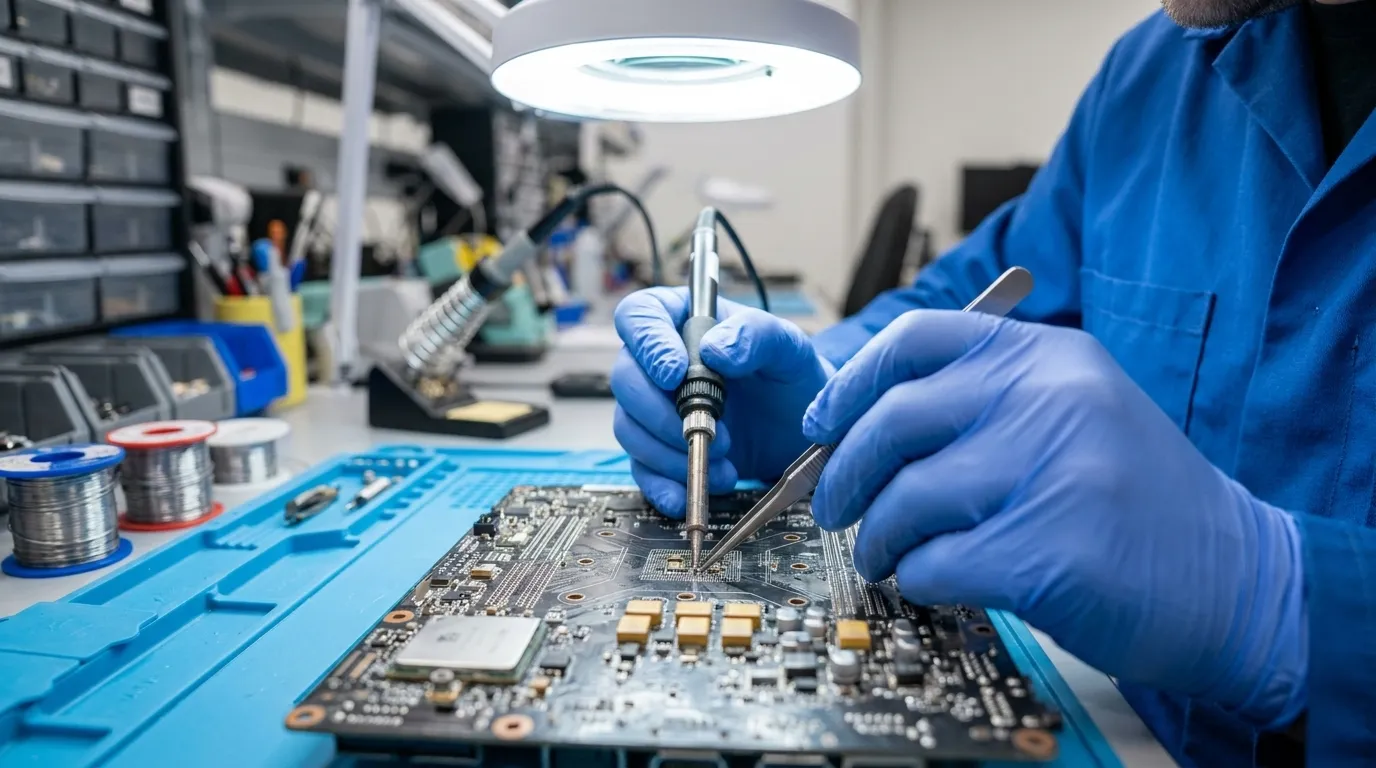
Depot repair is organized into four levels that reflect the depth of intervention required. Level 1 covers software reloads, firmware updates, basic diagnostics and reset procedures, which provide the fastest path to redeployment. Level 2 addresses component-level replacements such as batteries, screens, keyboards and modular assemblies without opening the core logic board. Level 3 involves board-level repair, including soldering, BGA reballing and sub-assembly replacement. Level 4 is full depot rebuild or remanufacture that returns the asset to original specification.
ASC authorization determines which OEM brands a repair center can service at each level without voiding warranties. Premier Logitech holds ASC status for more than 20 OEM brands and covers the full L1-through-L4 range. Multiple depot repair work orders can be created for a single RMA to manage work and costs across multiple locations in a complex supply chain. That capability supports enterprise programs that route assets across regional depots before final disposition and need accurate cost and status tracking.
Strategies that shorten RMA cycle times
Strong triage and diagnostics cut no-fault-found outcomes and shorten claim cycle time. That improvement starts at intake, where structured triage uses barcode scanning, condition grading and automated routing to remove manual decision points that slow throughput.
Premier Logitech’s DFW hub and nearshore operations in Laredo and Nuevo Laredo position inbound assets close to major carrier networks. Real-time TMS visibility gives program managers live status across every unit in the pipeline and supports proactive exception management that prevents small delays from turning into missed service levels.
Compliance and data-security requirements for RMA repair
Enterprise and government RMA programs operate under overlapping compliance frameworks. TAA, or Trade Agreements Act, governs the sourcing and handling of technology assets in federal programs. NIST frameworks establish cybersecurity and data-handling standards for organizations that manage sensitive information. CMMC, or Cybersecurity Maturity Model Certification, is required for defense contractors and their supply chain partners. SOC 2 certification validates that a service provider’s controls for security, availability and confidentiality meet defined standards.
Compliance in reverse logistics requires serialization, condition data captured at intake, chain-of-custody records and audit trails to support compliance and claims. Premier Logitech maintains TAA, NIST, CMMC, SOC 2, ISO 9001 and ISO 14001 certifications, along with CAGE Code 4WAJ9 for federal program eligibility. Secure data destruction occurs at every applicable stage and is documented with compliance reporting that supports audits and customer requirements.
Comparing in-house and outsourced reverse logistics
Organizations that manage RMA repair in-house retain direct control over workflow design, staffing and system integration. That control comes with fixed infrastructure costs, OEM authorization requirements and the operational burden of scaling capacity during volume spikes. Without ASC status, in-house teams cannot perform warranty repairs on branded equipment, which forces parallel vendor relationships and weakens consolidation efforts.
Outsourcing logistics operations can deliver flexible capacity and reduced fixed assets, but requires clear SLAs, scan compliance and exception reporting to maintain transparency and control. Splitting that outsourced work across multiple vendors distributes operational risk but introduces new problems, including coordination overhead, inconsistent data standards and gaps in chain-of-custody documentation.
A single-source outsourced model with a partner that holds broad ASC authorizations, compliance certifications and integrated TMS visibility addresses the core weaknesses of both alternatives. Vendor consolidation reduces the number of primary suppliers, improves control, standardizes shipping, reduces service-level variation and strengthens negotiating power and compliance tracking. Premier Logitech is structured for that role and operates as a modular or full-lifecycle partner depending on program requirements.
Checklist for evaluating reverse logistics partners
- ASC authorization for the OEM brands in the program’s device portfolio
- Demonstrated L1-L4 repair capability with documented work instructions and test protocols
- TAA, NIST, CMMC and SOC 2 certifications for government and enterprise eligibility
- Real-time TMS and inventory visibility integrated with client ERP systems
- Scalable repair capacity that absorbs volume spikes without cycle-time degradation
- Secure data destruction with documented chain-of-custody and compliance reporting
- In-warranty and out-of-warranty claim support across repair, replacement and credit RMA types
- Nearshore or domestic operations that reduce inbound transit time
- Refurbishment and grading capability for secondary market recovery
- Single point of contact for program management across all lifecycle stages
Premier Logitech meets each criterion and operates from three DFW facilities with nearshore capacity in Mexico and ASC authorizations across multiple OEM brands.
Frequently asked questions about RMA repair
What is the difference between depot repair and field repair in a reverse logistics program?
Depot repair routes assets to a centralized facility for diagnosis, repair and testing under controlled conditions. Field repair dispatches a technician to the asset location for on-site resolution. Depot repair supports deeper L2-L4 interventions, higher-volume throughput and stricter quality controls. Enterprise programs typically use depot repair for warranty and out-of-warranty claims where asset condition documentation and compliance reporting are required.
How does ASC authorization affect RMA repair options?
An authorized service center designation from an OEM grants the repair facility permission to perform warranty repairs on that brand’s products without voiding coverage. Without ASC status, a repair center cannot legally perform in-warranty service on branded equipment. For enterprise programs that manage devices from multiple OEM brands, a partner with broad ASC authorizations removes the need for separate vendor relationships for each brand.
What data security steps are required during RMA processing?
As covered in the compliance section, any device that may contain sensitive data requires documented data sanitization aligned with NIST 800-88 guidelines. Programs apply secure wipe protocols, maintain chain-of-custody records from intake through destruction or redeployment and provide compliance reporting for audit purposes. Programs that serve government agencies or defense contractors also follow CMMC-aligned handling procedures.
How does a single-vendor model improve RMA cycle time?
Fragmented vendor relationships introduce handoff delays, inconsistent data formats and gaps in asset visibility between stages. A single-vendor model removes inter-vendor transit, standardizes intake and triage procedures and maintains a continuous data record from RMA initiation through final disposition. Real-time TMS visibility across all stages allows program managers to identify and resolve exceptions before they grow into cycle-time failures.
What happens to assets that cannot be repaired?
Assets that fail repair triage move to refurbishment for cosmetic recovery, parts harvesting for component reuse or responsible recycling for compliant end-of-life disposition. Grading at intake determines the recovery path. Premier Logitech supports all three outcomes and provides certified recycling and secure data destruction documentation for each unit processed through end-of-life channels.
Next steps for building a stronger RMA program
A structured reverse logistics RMA repair program that uses ASC-authorized depot repair, real-time visibility and full compliance documentation recovers more asset value, compresses cycle time and reduces the operational risk that fragmented vendor models create. Assets that remain unprocessed because of fragmented handling lose significant resale value within weeks, so program design and partner selection directly shape recovery outcomes.
Premier Logitech brings together every capability on the partner-evaluation checklist, including ASC authorizations, L1-L4 repair, TAA, NIST, CMMC and SOC 2 compliance, TMS visibility and nearshore operations, under a single program structure. The result is a reverse logistics operation that scales with volume, meets compliance requirements and returns strong value from every asset in the pipeline.
Talk to a lifecycle expert and build a more efficient RMA repair program today.
