Key Takeaways
- Mobile reverse logistics services manage the full post-sale lifecycle of smartphones and wireless devices through intake, secure data wiping, triage, repair, refurbishment and responsible disposition.
- Enterprise programs must meet strict compliance standards including NIST SP 800-88, CMMC 2.0, TAA, SOC 2 and ISO 9001/14001 to protect data and meet regulatory requirements.
- Value recovery improves when devices move quickly through AI-assisted triage, OEM-authorized repairs and established secondary-market channels for certified pre-owned resale.
- Selecting a partner requires evaluation of OEM authorization, repair capacity, compliance certifications, geographic footprint, real-time visibility and single-vendor consolidation capabilities.
- Premier Logitech delivers certified, scalable mobile reverse logistics services; talk to a lifecycle expert to design a compliant, high-recovery program.
Core Components of Mobile Reverse Logistics Services
A mature mobile reverse logistics program covers every stage from the moment a device leaves an end user to its next destination. These services group into intake and assessment, repair and recovery, and final disposition. Core service components include:
- RMA management: Structured return merchandise authorization intake that captures device identity, condition and entitlement data before physical receipt.
- Receiving and inventory scan: Serialized check-in that ties each unit to a chain-of-custody record from the point of induction.
- Secure data wiping: Certified erasure aligned to NIST SP 800-88 and other applicable standards, with tamper-proof certificates of destruction issued per device.
- Triage and diagnostics: AI-assisted functional testing and cosmetic inspection that routes each device to the optimal disposition path.
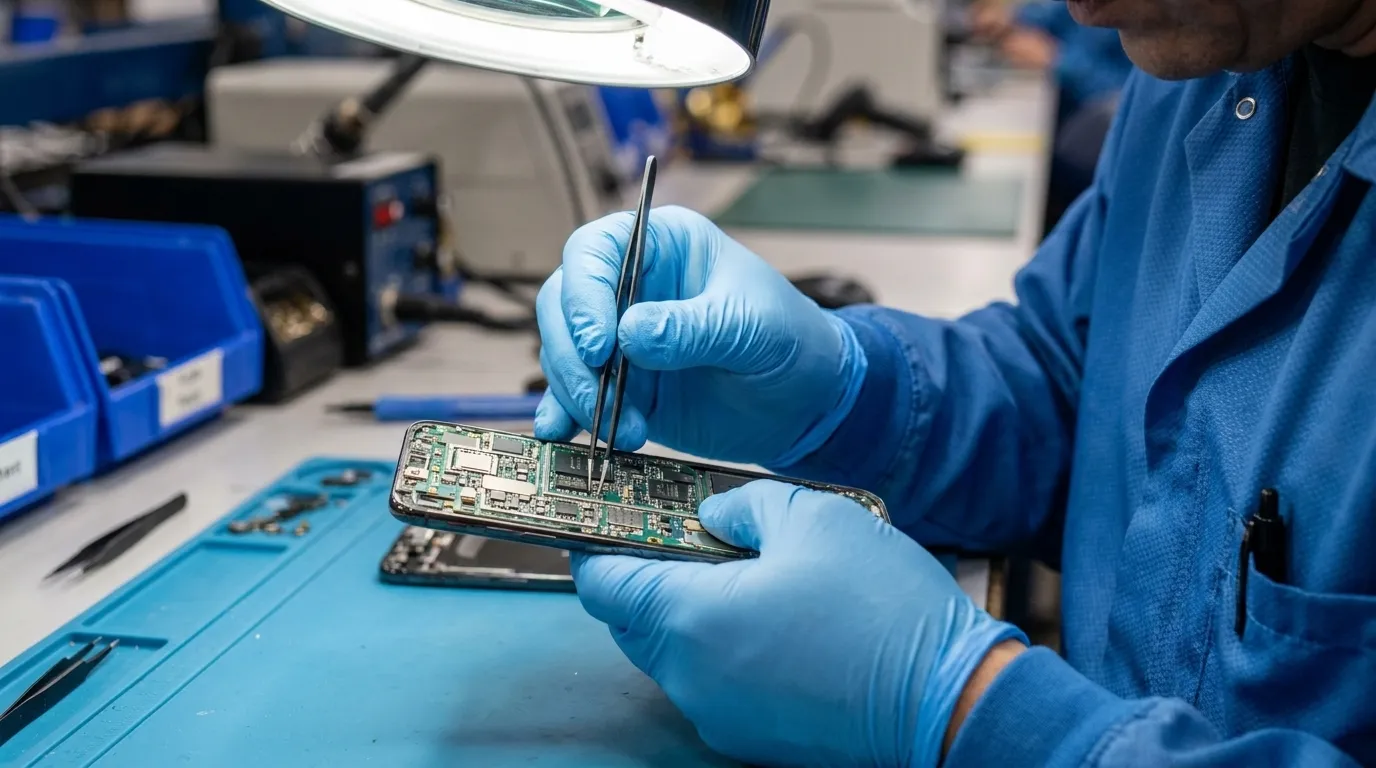
- Depot repair (L1–L4): Component-level repair from screen replacement and battery swap through board-level and BGA rework, performed by OEM-authorized technicians.
- Sorting and grading: Condition-based classification that determines resale tier and informs value-recovery pricing.
- Certified refurbishment: Cosmetic and functional restoration that prepares devices for secondary-market channels, carrier-certified pre-owned programs or enterprise redeployment.
- Trade-in management: End-to-end processing of upgrade and trade-in programs, including eligibility verification, valuation and settlement reporting.
- Parts reclamation and harvesting: Recovery of serviceable components from beyond-economic-repair units to support repair pipelines and reduce procurement costs.
- Responsible recycling and e-waste disposal: Certified downstream processing for units that cannot be refurbished, aligned to ISO 14001 and applicable e-waste regulations.
Talk to a lifecycle expert about building a program that covers every one of these stages under a single contract.
Step-by-Step Mobile Reverse Logistics Workflow
The following seven-step workflow reflects current best practice for enterprise mobile device reverse logistics programs in 2026.
- RMA creation and shipment: The enterprise or carrier generates an RMA, applies a label or QR code and ships the device to the designated intake facility. Label-free return options reduce friction for high-volume programs.
- Receiving and inventory scan: Each unit is scanned on arrival, matched to its RMA record and assigned a serialized asset tag. This step opens the chain-of-custody log that follows the device through every subsequent stage.
- Secure data wiping: Certified erasure uses methods defined by NIST SP 800-88, with Clear, Purge or Destroy methods selected based on data sensitivity. A tamper-proof certificate of destruction is generated per device.
- AI-assisted triage and diagnostics: Automated functional testing and cosmetic inspection classify each device by condition and repair requirement. Robotics and AI are now used by leading operators to assess device quality and process trade-ins with greater speed and consistency, which supports higher average selling prices for recovered units.
- Repair or refurbishment: Devices routed for repair enter the appropriate depot level (L1–L4). Units routed for refurbishment receive cosmetic restoration and functional validation before grading.
- Grading and value assessment: Each processed unit receives a condition grade that determines its disposition path and informs settlement reporting for trade-in and warranty programs.
- Redeployment, resale or responsible recycling: Graded devices move to enterprise redeployment, certified pre-owned channels, secondary-market resale or certified e-waste recycling. Businesses with optimized reverse logistics often recover more of the original value of returned items compared to reactive systems. Strong compliance at every step protects that value.
Data Security and Compliance Requirements for Enterprise Programs
Compliance sits at the center of enterprise mobile reverse logistics. Government agencies, telecom carriers and large OEMs operate under overlapping frameworks that govern how data is destroyed, how assets are tracked and how downstream vendors are held accountable.
NIST SP 800-88: NIST SP 800-88 remains the most commonly used data erasure standard and defines Clear, Purge and Destroy sanitization methods for media. Enterprise programs select the method appropriate to data sensitivity and document successful application for every device processed.
CMMC 2.0: Organizations handling controlled unclassified information for the Department of Defense align sanitization and disposition processes to CMMC 2.0 requirements. This framework applies to any reverse logistics partner that touches devices containing government data.
TAA (Trade Agreements Act): Federal procurement programs require TAA-compliant sourcing and handling. Reverse logistics partners that support government agencies maintain TAA compliance across repair, refurbishment and redeployment workflows.
SOC 2: SOC 2 Type II attestation shows that a provider’s security, availability and confidentiality controls have been independently audited, a baseline expectation for enterprise and carrier programs.
ISO 9001 / ISO 14001: ISO 9001 ensures processes are consistent, repeatable and continuously improving, while ISO 14001 supports responsible recycling and compliance with environmental regulations.
Chain-of-custody documentation and certificates of destruction form required outputs of any compliant program. A compliant disposition strategy in 2026 includes documented chain of custody, verified data destruction reporting and transparency into downstream recycling and reuse.
Premier Logitech holds TAA, TAPA, ISO 9001/14001, NIST, CMMC and SOC 2 certifications and operates as an OEM-authorized service center for more than 20 brands. The company’s CAGE Code 4WAJ9 identifies it as a pre-vetted, high-security partner for U.S. federal government programs.
Value Recovery and Refurbishment Economics
A structured mobile reverse logistics program creates a clear financial case backed by current market data.
A remanufactured smartphone can be offered at a meaningful discount to new-device pricing while still generating strong margin for the program operator. Refurbished returned electronics are typically inspected, repaired and resold at 30-60% below the new retail price (40-70% of original). Speed of processing shapes recovery value. A returned item processed through slower centralized inspection may recover less of its value, while the same item quickly sorted and resold while demand remains high can recover more of its value.
The cost of inaction is equally significant. Without structured triage and disposition workflows, processing a single return can consume a significant portion of the product’s original price in labor and handling costs, which erases potential recovery value.
Parts reclamation adds another recovery layer. Components harvested from beyond-economic-repair units re-enter the repair supply chain, reduce parts procurement costs and support repair throughput for in-warranty and out-of-warranty programs.
The broader market reflects this value. The North America reverse logistics market reached USD 186.6 billion in 2025 and is expected to grow at a 7.1% CAGR from 2026 to 2035. The remanufacturing segment captured 28% of the global reverse logistics market in 2025, driven by circular economy objectives and advanced diagnostics that enable higher recovery value in electronics.
How to Choose a Mobile Reverse Logistics Partner
Partner selection shapes program performance more than any other design choice. The following checklist reflects criteria that enterprise operations and supply chain leaders apply when evaluating providers. These seven factors cover technical capability, compliance posture and operational resilience, the core pillars of a reliable reverse logistics partnership.
- OEM authorization: ASC status for the brands in the device portfolio is nonnegotiable for warranty-valid repair. Partners without authorizations cannot perform in-warranty repairs and create compliance exposure.
- Repair capacity and scalability: High-volume programs require a partner with demonstrated capacity to absorb return spikes without degrading cycle times. Premier Logitech operates at high repair volumes across its DFW facilities.
- Compliance certifications: Programs verify TAA, NIST, CMMC, SOC 2 and ISO 9001/14001 coverage. Government and carrier programs require documented proof, not self-attestation.
- Geographic footprint: A DFW logistics hub combined with nearshore operations in Mexico (Laredo/Nuevo Laredo) provides proximity to major carrier networks and cost-effective processing capacity. Nearshoring reduces lead times, transportation costs and geopolitical risks while improving resilience.
- Real-time visibility: Programs need live inventory tracking, exception reporting and disposition dashboards. Lack of visibility is a primary driver of missed recovery value and compliance gaps.
- Single-vendor consolidation: Third-party logistics providers held a 38% share of the global reverse logistics market in 2025 by offering end-to-end solutions that replace fragmented vendor relationships. A single partner that manages repair, refurbishment, fulfillment and recycling reduces coordination overhead and compliance risk.
- Secondary-market and remarketing capability: The partner maintains established channels for certified pre-owned resale and the grading infrastructure that supports them.
Talk to a lifecycle expert at Premier Logitech to evaluate whether a single-source model fits the program’s volume, compliance and recovery objectives.
Enterprise Use Cases by Industry
Telecom Carrier Device Returns
Telecom carriers manage some of the highest device return volumes in the industry, driven by upgrade cycles, trade-in promotions and warranty claims. Leading carriers have expanded reverse logistics agreements and opened dedicated logistics facilities to handle increased device flows. Carrier programs require rapid intake, certified data wiping, grading for certified pre-owned channels and real-time settlement reporting. Return streams now include wearables, accessories and connected devices beyond smartphones.
OEM Warranty and Repair Programs
OEMs need ASC-authorized repair partners to protect warranty program integrity and brand standards. High-volume depot repair at L1–L4 levels, parts reclamation and refurbishment for secondary-market channels form core requirements. OEMs also benefit from a partner that can consolidate repair, fulfillment and recycling under one contract, which reduces vendor management complexity.
Consumer Electronics Brand Returns
Consumer electronics brands face rapid product obsolescence and high return rates across ecommerce and retail channels. Electronics reverse logistics is driven by rapid product obsolescence, warranty claims and e-waste regulations. Brands need refurbishment and grading capabilities that support certified pre-owned programs and ESG reporting on e-waste diversion.
Government and Public-Sector Devices
Federal and state agencies require TAA-compliant handling, NIST SP 800-88-aligned data destruction, CMMC 2.0 compliance and full chain-of-custody documentation for every device processed. Premier Logitech’s CAGE Code 4WAJ9 and established compliance certifications make it a pre-vetted option for public-sector programs that cannot accept unverified vendors.
Frequently Asked Questions
Compliance Standards for Mobile Device Returns and Data Wiping
Enterprise and government programs typically require alignment to NIST SP 800-88 for data sanitization, which defines Clear, Purge and Destroy methods based on data sensitivity. CMMC 2.0 applies to programs involving controlled unclassified information for the Department of Defense. TAA compliance governs federal procurement. SOC 2 Type II attestation and ISO 9001/14001 certification are standard expectations for carrier and OEM programs. Every compliant program produces certificates of destruction and serialized chain-of-custody records for each device processed.
Differences Between L1 and L4 Depot Repair
Depot repair levels describe the depth of technical intervention applied to a returned device. L1 covers basic diagnostics, software resets and cosmetic cleaning. L2 includes component replacement such as screens, batteries and charging ports. L3 addresses subassembly repair and more complex hardware faults. L4 involves board-level repair, BGA rework and component-level diagnostics. OEM authorization is required to perform warranty-valid repairs at any level for branded devices.
Impact of Single-Vendor Consolidation on Program Performance
Fragmented vendor relationships across repair, fulfillment and recycling create coordination gaps, inconsistent compliance documentation and missed recovery value. A single-source partner manages intake, data wiping, triage, repair, grading, remarketing and recycling under one contract and one chain-of-custody record. This structure reduces the number of handoffs where devices can be lost, misgraded or improperly disposed of. It also simplifies compliance audits because all documentation originates from one provider.
Role of Nearshore Processing in Reverse Logistics Economics
Nearshore operations in locations such as Laredo/Nuevo Laredo, Mexico, provide access to cost-effective labor for high-volume processing tasks while maintaining proximity to U.S. logistics hubs. This model supports competitive processing economics without the lead-time exposure of offshore operations. For programs with large return volumes, nearshore capacity can absorb surge periods without domestic facility expansion. Premier Logitech operates nearshore facilities alongside its DFW logistics hub to support this model.
Key Metrics for Mobile Reverse Logistics Performance
Core performance metrics include inspection cycle times, recovery rates by device grade, disposition accuracy, labor productivity per unit and chain-of-custody audit pass rates. Value recovery rate, the percentage of original device value recovered through refurbishment and resale, serves as the primary financial metric. Compliance metrics include certificate of destruction issuance rates and audit findings. Real-time visibility into inventory status and disposition outcomes allows program managers to identify bottlenecks and adjust routing decisions before value degrades.
Conclusion: A Practical Evaluation Framework
Enterprise mobile reverse logistics programs succeed or fail based on three variables: compliance coverage, repair authorization and operational scale. A partner that holds the right certifications but lacks OEM authorization cannot perform warranty-valid repairs. A partner with authorization but limited capacity cannot absorb enterprise return volumes. A partner with capacity but no real-time visibility cannot support the reporting requirements of carrier, OEM or government programs.
Premier Logitech addresses all three. The company holds the full suite of certifications required for government and carrier programs, maintains OEM authorization across its brand portfolio, processes high repair volumes across DFW and nearshore facilities and delivers real-time inventory and lifecycle visibility across every program it manages.
For operations and supply chain leaders evaluating a single-source partner for mobile reverse logistics services, the decision framework centers on certifications, authorization, capacity, visibility and consolidation capability. Premier Logitech is built to meet all five criteria.
Talk to a lifecycle expert at Premier Logitech to assess program fit and build a proposal aligned to volume, compliance and recovery objectives.
