Key Takeaways for Enterprise Mobile Repair Programs
- High-capacity mobile repair uses a structured supply-chain process that handles tens of thousands of devices weekly under strict compliance and security standards.
- Fragmented repair networks create bottlenecks, visibility gaps, compliance risks and lost asset-recovery value for enterprises and government agencies.
- Premier Logitech operates L1–L4 depot capabilities across multiple facilities, supporting triage, component repair, board-level fixes and OEM-authorized engineering services.
- ASC status with 20+ OEM brands, ISO and TAPA certifications and NIST-aligned frameworks support genuine parts, warranty compliance and audit-ready documentation.
- Premier Logitech connects repair with reverse logistics and rapid exchange programs; talk to a lifecycle expert to consolidate a high-volume mobile repair program today.
Rising Return Volumes and the Cost of Fragmented Repair Networks
Large enterprises, telecom carriers and government agencies face a structural problem: return volumes are rising while repair networks remain fragmented. Enterprises are shortening hardware refresh cycles from five to seven years down to three to four years. This shift pushes higher volumes of mobile devices into recovery and refurbishment channels faster than most multi-vendor networks can absorb them.
Fragmentation creates four compounding problems. First, bottlenecks form when no single vendor has the throughput or authorization to handle all device types. These bottlenecks create visibility gaps across handoffs between intake, repair, grading and remarketing partners, since no party tracks the full journey. The resulting documentation inconsistencies increase compliance exposure when chain-of-custody records do not align across vendors. Asset recovery value then erodes as devices sit idle waiting for routing decisions or repair authorization, delays that stem directly from the coordination overhead of multi-vendor networks.
Resale and remarketing services led the IT asset disposition market with a 36.95% revenue share in 2025, and the market is projected to grow from USD 24.4 billion in 2025 to USD 39.66 billion by 2031 at an 8.45% CAGR. This growth confirms that recovered device value is significant and that organizations leaving devices in fragmented pipelines forfeit measurable returns.
Four-Level Depot Structure for Enterprise-Scale Mobile Repair
Enterprise-scale mobile repair relies on structured depot capabilities across four levels. Each level addresses a distinct category of device condition and repair complexity.
L1 (Triage and Sorting): Intake, visual inspection, functional testing and routing decisions. Devices are sorted by condition, warranty status and repair path.
L2 (Component-Level Repair): Screen replacement, battery swap, port repair and cosmetic refurbishment. This level handles the highest volume of consumer and enterprise returns.
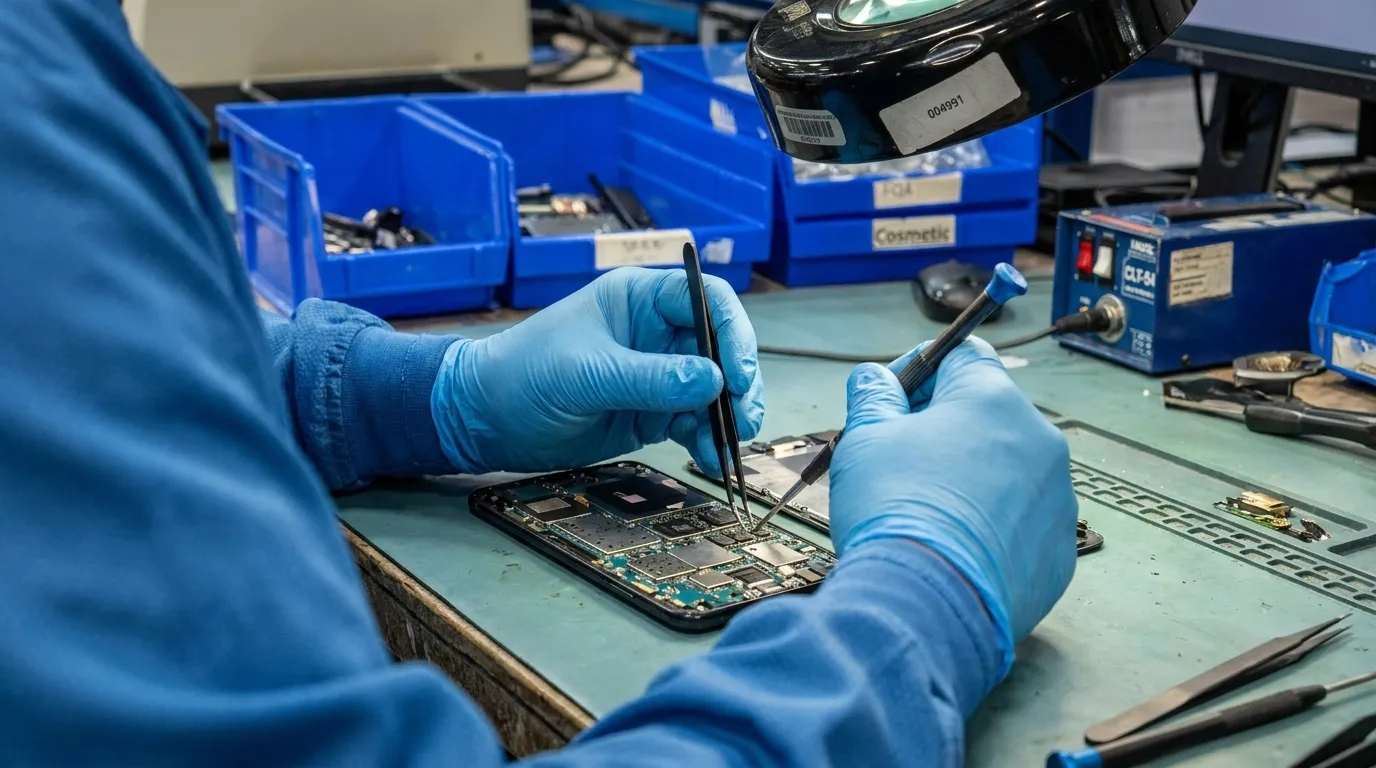
L3 (Board-Level Repair): PCB diagnostics, BGA reballing, microsoldering and advanced component replacement. This level requires specialized equipment and certified technicians.
L4 (Engineering and OEM-Level Repair): Root-cause analysis, firmware recovery, engineering change order implementation and failure reporting back to OEM partners. This level requires active OEM authorization and access to proprietary diagnostics.
Premier Logitech operates across all four levels. The network supports in-warranty and out-of-warranty claims, cosmetic refurbishment, parts reclamation and secure data destruction within the same facility footprint.
Compliance and Security Standards for Government and Enterprise Programs
Government and regulated enterprise programs require repair partners to demonstrate verifiable compliance, not just self-reported adherence. The NSA Zero Trust Implementation Guideline Phase One aligns its device pillar requirements with NIST SP 800-207. This alignment establishes NIST guidance as the baseline for secure device handling in government environments.
The same guideline defines device inventory management, automated asset and vulnerability tracking and Unified Endpoint Management as foundational capabilities for any partner handling government endpoints. Partners that meet these standards support consistent control across the full device lifecycle.
Premier Logitech holds ISO quality framework certifications and TAPA certification. These frameworks support chain-of-custody control and audit-ready documentation requirements across government and commercial programs.
Advantages of OEM Authorized Service Center Status
Authorized Service Center status functions as a contractual relationship with an OEM that grants access to genuine parts, proprietary diagnostics, warranty claim processing and certified repair procedures. Without ASC status, a repair provider cannot legally perform in-warranty repairs for most major OEM brands. Repairs performed outside this framework may void device warranties.
Premier Logitech holds ASC authorizations with more than 20 OEM brands. This breadth creates three structural advantages for enterprise clients. Genuine parts access reduces repair failure rates and supports warranty compliance. OEM-certified procedures ensure repairs meet manufacturer specifications, which matters for government and carrier programs with strict quality requirements. Direct OEM relationships also enable faster parts procurement and engineering escalation paths that independent repair providers cannot access.
For OEM mobile device repair programs, ASC status allows the repair partner to process returns, validate warranty claims and feed failure data back to the OEM. This feedback loop connects field returns with product quality improvement.
Connecting Repair, Reverse Logistics, Asset Recovery and Rapid Exchange
High-volume mobile repair delivers the strongest results when it operates as part of an integrated reverse logistics program rather than as a standalone service. The combination of depot repair, asset recovery and rapid exchange creates a closed-loop system. Returned devices then move efficiently from intake to disposition without manual routing decisions at each handoff.
Device-as-a-Service contracts embedding reverse-logistics clauses are driving predictable return volumes and reducing grey-market leakage. Organizations with integrated programs report better forecasting accuracy for remarketing channels. Full-Stack Asset Lifecycle Management services are forecast to expand at a 12.25% CAGR through 2031 as enterprises consolidate procurement, maintenance and disposition under single agreements.
Rapid exchange programs, where a functional replacement device ships before or at the same time as the return of a defective unit, reduce end-user downtime and limit productivity loss. Premier Logitech supports rapid exchange and next-day replacement programs as part of its reverse logistics portfolio. RMA management, sorting, grading and redeployment operate within the same network, which shortens cycle times and improves asset utilization.
Evaluation Criteria for Selecting a High-Capacity Repair Partner
Selecting a high-capacity mobile repair partner requires clear criteria aligned with current program requirements and projected growth. Key evaluation areas include:
- OEM authorization breadth and ASC status documentation for all covered device brands
- Throughput capacity at peak return volumes and seasonal spikes
- Compliance certifications that match the regulatory environment, including NIST-aligned frameworks
- Integration capabilities with existing reverse logistics, RMA and asset management systems
- Reporting and visibility tools that provide real-time tracking and performance metrics
- Geographic coverage and nearshore options for cross-border or multi-region programs
- Total cost of ownership, including hidden handoff, delay and transportation costs
Talk to a lifecycle expert to map current return flows against these criteria.
Common Pitfalls With Internal or Multi-Vendor Repair Models
Organizations that manage high-volume mobile repair internally or distribute it across multiple vendors encounter predictable failure modes. Vendor fragmentation is the most common pattern. Each vendor focuses on its own scope, which creates handoff delays, inconsistent documentation and no single point of accountability for program performance.
Compliance exposure forms the second major risk. When chain-of-custody documentation comes from multiple systems with different data standards, audit readiness becomes difficult to maintain. For government programs, this fragmentation can result in contract non-compliance. For enterprise programs, it creates liability around data destruction and asset disposition.
The third pitfall is missed recovery value. The asset recovery opportunity outlined earlier reflects the scale of revenue available in returned devices. Organizations without a structured refurbishment and grading program leave secondary-market revenue on the table while also incurring disposal costs.
Frequently Asked Questions
How can organizations trust a high-volume repair partner?
Trust in a high-volume repair partner rests on verifiable credentials, not self-reported claims. Organizations should require documentation of OEM Authorized Service Center status, compliance certifications such as TAA, NIST, CMMC and SOC 2, chain-of-custody protocols and audit-ready reporting. Premier Logitech holds ASC status with more than 20 OEM brands and carries certifications across major government and enterprise compliance frameworks, including a CAGE Code for federal procurement eligibility.
Is repair or replacement the better choice at scale?
The better choice depends on device age, condition grade and program economics. At enterprise scale, a structured triage process at L1, including sorting and functional testing, determines the optimal path for each device. Devices with high residual value and repairable defects often generate stronger returns through L2 or L3 repair and remarketing than through replacement. Rapid exchange programs address end-user downtime while the original device moves through the repair pipeline, which makes repair and replacement complementary strategies.
What should organizations look for in an authorized repair network?
An authorized repair network must hold active OEM ASC status for the device brands in the program and operate at the throughput required by peak return volumes. The network also needs compliance documentation that satisfies the organization’s regulatory environment. Network coverage, nearshore capabilities and integration with reverse logistics and asset recovery programs further determine whether a partner can scale with program growth. Premier Logitech’s DFW hub and Mexico nearshore operations support both domestic and cross-border program requirements.
How does high-capacity mobile repair support ESG and sustainability goals?
Certified refurbishment and responsible recycling programs reduce e-waste by extending device lifecycles and diverting assets from landfills. Organizations with ESG procurement benchmarks benefit from partners that provide compliance reporting on recycling, data destruction and secondary-market disposition. Premier Logitech operates e-waste reduction programs and responsible recycling services alongside its repair and remarketing capabilities, which supports sustainability reporting requirements.
Conclusion: Building a Scalable, Compliant Mobile Repair Program
Enterprise mobile repair programs perform best when they consolidate vendors, operate under verified compliance frameworks and connect repair with reverse logistics and asset recovery. The evaluation framework above, covering service scope, technical capabilities, compliance, scalability, visibility, network coverage and total cost of ownership, offers a structured basis for assessing any prospective partner.
The next step is to map current return flows against weekly volume, device mix and compliance requirements, then request a capabilities discussion with a partner that can demonstrate ASC status, certified compliance and documented throughput at enterprise scale. Premier Logitech has operated at this scale since 2007, serving OEMs, telecom providers, enterprises and government agencies across the full technology lifecycle.
Talk to a lifecycle expert to start a capabilities discussion for a mobile repair program.
