Key Takeaways
- Fragmented local repair networks create vendor sprawl, inconsistent quality, data-security gaps and limited scalability for enterprise and government device fleets.
- Authorized depot repair services deliver OEM-standard charging-port repairs, standardized quality control and integrated reverse logistics in one centralized program.
- Consolidating to one partner reduces procurement overhead, improves SLA enforcement and provides unified visibility into repair status, grading and asset recovery.
- Centralized depot operations accelerate turnaround, maintain chain-of-custody documentation and support compliance frameworks including NIST, CMMC and SOC 2.
- Premier Logitech replaces fragmented repair networks with a scalable, compliant depot program; connect with a lifecycle specialist to consolidate charging-port repair services.
The Cost of Fragmented Charging Port Repair Networks
Enterprise and government device fleets generate a steady volume of charging-port failures. When organizations route those repairs through consumer-focused local shops or disconnected regional vendors, several compounding problems emerge.
Vendor sprawl is the most visible symptom. When operations teams manage dozens of repair relationships, each vendor operates on its own timeline, uses its own parts sourcing and applies its own quality standards or none at all. This fragmentation produces inconsistent pricing, variable quality and no unified reporting, which prevents performance benchmarking and consistent standard enforcement.
Data-security exposure follows. Local repair shops rarely carry chain-of-custody documentation, secure data-handling protocols or compliance certifications that enterprise and government programs require. A device sent to an unauthorized shop for a charging-port repair can create audit gaps that affect broader compliance posture under frameworks such as NIST, CMMC and SOC 2.
Visibility gaps compound the cost. Without centralized tracking, returned devices disappear into repair queues with no status updates, no grading data and no recovery projections. Recovery value rate is a standard KPI in integrated programs, but fragmented networks rarely measure it at all.
Scalability becomes the final constraint. A local shop network that handles dozens of repairs per week cannot absorb a surge of thousands of units from a fleet refresh, warranty campaign or product recall. Organizations that have not pre-qualified a high-volume depot partner discover this limitation at the worst possible moment. These compounding problems point to a structural solution based on centralized depot repair.
Centralized Depot Repair with Integrated Reverse Logistics
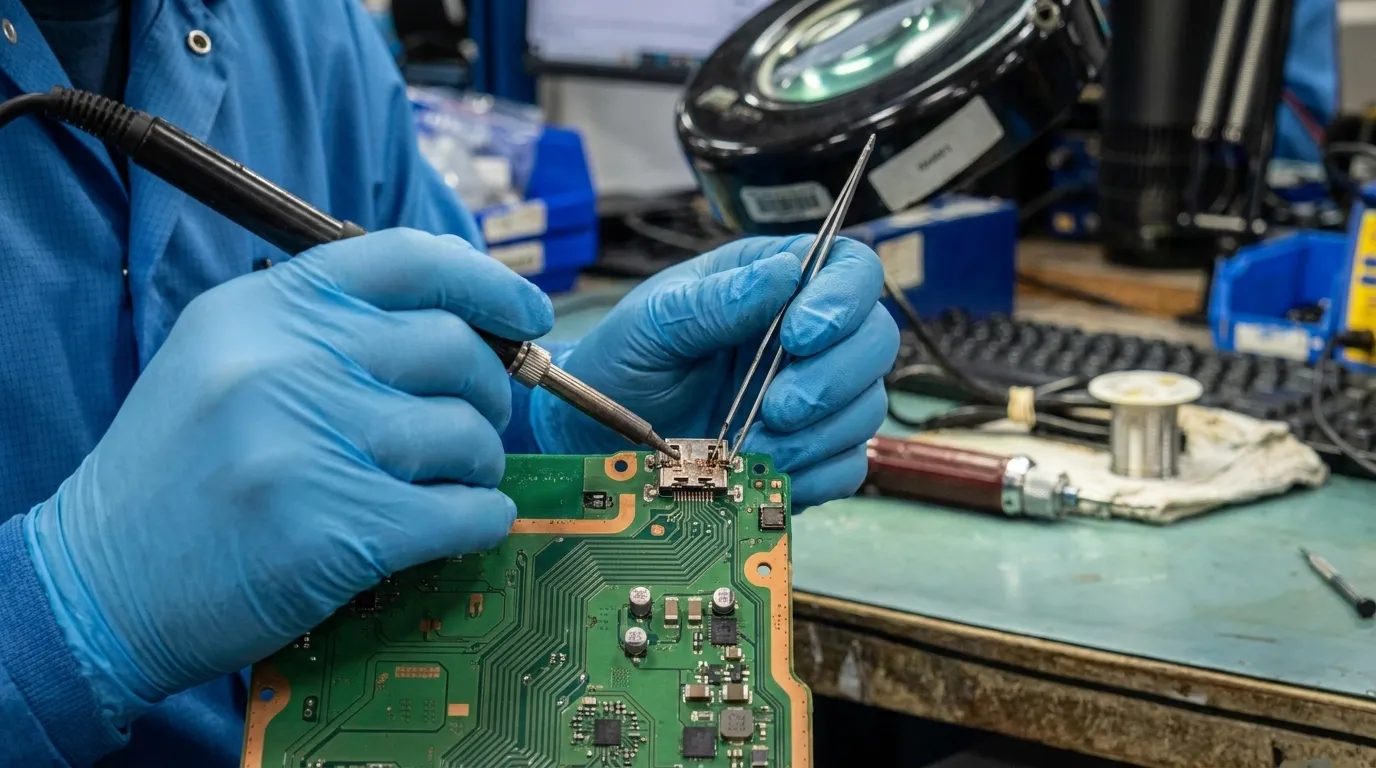
Depot-based repair performed in centralized facilities gives OEMs and large enterprises access to specialized tools, trained technicians and standardized quality-control processes that are typically unavailable in field or local repair settings.
An authorized depot repair program for charging-port failures typically follows a structured workflow. Devices enter through a managed RMA intake process, then teams triage units and assign a repair level based on fault complexity. After repair, units move through grading and cosmetic refurbishment before redeployment or disposition.
Premier Logitech operates this full workflow at high capacity across its DFW facilities, with nearshore operations in Laredo and Nuevo Laredo. The company holds Authorized Service Center status with more than 20 OEM brands, so repairs meet OEM specifications and preserve warranty integrity, a requirement that consumer repair shops cannot satisfy.
Integration with reverse logistics closes the loop. Rather than treating repair as an isolated transaction, Premier Logitech connects RMA intake, repair, grading, asset recovery and remarketing into one managed program. Refurbishment yield functions as a core metric in integrated programs and centralized depot operations are positioned to improve that rate.
Vendor Consolidation with a Single Depot Repair Partner
Managing charging-port repairs across a distributed vendor network introduces procurement overhead, inconsistent SLA enforcement and fragmented data. Each additional vendor relationship adds contract management, invoice reconciliation and quality-audit burden to operations teams that already manage complex device fleets.
A single authorized depot partner removes much of that complexity. Key evaluation criteria when consolidating repair vendors include:
- OEM ASC authorization status across the device brands in the fleet
- Demonstrated capacity to absorb peak repair volumes without queue degradation
- Single-platform visibility into repair status, grading outcomes and asset disposition
- Modular service options that allow organizations to engage for repair only or expand to full lifecycle management
- A single point of contact for program management, escalation and reporting
Operating as a single global partner for depot repair and reverse logistics allows OEMs and enterprises to scale service offerings from one point of contact rather than coordinating across fragmented regional networks. Premier Logitech applies this model nationally, and its centralized DFW hub supports clients across IT, telecom, consumer electronics and public-sector verticals while removing the need to manage separate regional vendors.
Review vendor consolidation scenarios with a Premier Logitech lifecycle specialist.
Reducing Returns and Repair Bottlenecks
Repair cycle time directly affects device availability, user productivity and secondary-market recovery windows. Fragmented local networks produce variable turnaround because each shop operates independently, without standardized intake, triage or quality-assurance processes.
Centralized depot operations address this through process standardization. L1 through L4 repair capabilities under one roof remove the handoffs and re-routing that slow distributed networks. Standardized grading combined with centralized returns processing reduces cycle time and improves value recovery, as automated sortation and unified data systems shorten processing time and improve forecast accuracy in reverse-logistics operations.
Organizations that evaluate depot partners for turnaround performance should assess:
- Documented repair-level capabilities and average cycle time by fault category
- Intake-to-disposition tracking with real-time status visibility
- Rapid exchange and next-day replacement program availability for critical fleet devices
- Capacity buffers for surge volumes tied to warranty campaigns or fleet refreshes
Meeting Compliance and Data-Security Standards
Charging-port repair may appear to be a low-risk service category, but every device that leaves an organization's custody carries data-security and chain-of-custody obligations. For government agencies and regulated enterprises, those obligations are enforceable.
Professional IT asset disposal within depot operations ensures data is destroyed and materials are handled according to environmental and regulatory requirements. This approach reduces the risk of data breaches and supports compliance for OEMs and government agencies. The same principle applies to devices in active repair, so chain-of-custody documentation must be maintained from intake through return shipment.
Premier Logitech supports TAA, ISO 9001/14001, NIST, CMMC and SOC 2 compliance frameworks. The company holds CAGE Code 4WAJ9, which identifies it as a pre-vetted partner for U.S. federal government programs. Secure depot programs issue data destruction certificates upon completion of wiping for recovered devices and maintain chain-of-custody records throughout the repair and disposition process.
Compliance evaluation criteria for depot repair partners include:
- Active certifications relevant to the organization's regulatory environment
- Documented chain-of-custody procedures from RMA intake through return or disposition
- Secure data-handling protocols for devices that retain storage components during charging-port repair
- Compliance reporting outputs compatible with internal audit and government contracting requirements
Closing Asset-Visibility Gaps and Increasing Value Recovery
Devices routed through fragmented repair networks frequently disappear from asset-tracking systems for the duration of the repair cycle. That visibility gap creates inventory inaccuracies, missed redeployment windows and lost secondary-market value.
Integrated depot programs close this gap through real-time tracking tied to RMA records, repair status and grading outcomes. Channel reentry of graded and repaired items through open-box, outlet or wholesale channels increases value recovery rates and speeds sell-through. Refurbishment and component harvesting raise value recovery rates on eligible SKUs and support end-of-life compliance tracking.
Key metrics organizations should track in an integrated program include the recovery value rate discussed earlier, along with refurbishment yield, disposal rate and restock rate. Processing turnaround time from receipt at the depot to final disposition directly affects how quickly recovered value re-enters the supply chain.
Premier Logitech's certified refurbishment and grading capabilities support secondary-market resale, parts reclamation and responsible recycling, with compliance reporting aligned to ISO and NIST requirements.
Comparing In-House, Multi-Vendor and Single-Partner Models
Organizations that manage high-volume charging-port repair programs typically operate under one of three models. Each model carries distinct trade-offs across scalability, compliance support, visibility and cost control.
In-house repair operations:
- Require capital investment in tools, parts inventory and trained technicians
- Face scalability limits tied to headcount and facility capacity
- Must self-maintain compliance documentation and OEM authorization
- Provide strong visibility within the operation but limited visibility at intake and disposition stages
Multi-vendor local repair networks:
- Use geographic distribution to reduce inbound shipping time for some devices
- Produce inconsistent quality, compliance posture and turnaround across vendors
- Lack a unified visibility platform, so reporting requires manual aggregation
- Vary in OEM authorization status by shop, which places warranty integrity at risk
Single authorized depot partner:
- Delivers centralized L1 to L4 repair with standardized quality control and OEM authorization
- Provides scalable capacity to absorb peak volumes without network reconfiguration
- Maintains unified compliance documentation, chain-of-custody tracking and reporting
- Integrates reverse logistics to connect repair with grading, recovery and disposition
Planning a Transition to a Consolidated Depot Program
Moving from a fragmented repair network to a consolidated depot program involves several operational steps. Organizations that plan the transition systematically reduce disruption to active device fleets.
The process typically begins with a program audit that catalogs current repair vendors, volume by device type, average cycle time and compliance gaps. That baseline informs the scope of the consolidated program and identifies which device categories to prioritize in the initial transition.
Premier Logitech's onboarding process starts with a scoping call to align on business challenges and program requirements. A customized proposal follows and covers repair levels, logistics integration, compliance documentation and reporting cadence. Modular engagement options allow organizations to begin with depot repair and add reverse logistics, grading or remarketing services as the program matures.
Start a transition assessment and map a consolidated depot program with Premier Logitech.
Frequently Asked Questions
What device types and repair levels does an authorized depot repair services program typically support?
Authorized depot repair programs support a broad range of enterprise and consumer device categories, including smartphones, tablets, laptops, wearables, peripherals and connected devices. Repair levels range from L1, which covers basic diagnostics, cleaning and cable replacement, through L4, which covers board-level and subassembly repair. Charging-port repair typically falls at L2 and involves component-level replacement, though devices with associated board damage may require L3 or L4 intervention. Premier Logitech's ASC authorizations with more than 20 OEM brands mean teams perform repairs to manufacturer specifications and preserve warranty integrity across the fleet.
How do certified depot partners maintain chain-of-custody and data-security compliance for enterprise fleets?
Certified depot partners maintain chain-of-custody through documented intake procedures, serialized tracking tied to each device's RMA record and audit-ready logs that follow the unit from receipt through repair, grading and final disposition. Data-security protocols include secure handling procedures for devices that retain storage components during repair, DoD-standard data wiping where applicable and issuance of data destruction certificates upon completion. For government and regulated enterprise programs, compliance documentation aligns with frameworks including NIST, CMMC, SOC 2 and ISO 9001/14001. Premier Logitech's CAGE Code 4WAJ9 designation reflects its status as a pre-vetted partner for federal government programs with these requirements.
What operational metrics should organizations expect from integrated reverse-logistics programs?
Integrated reverse-logistics programs are typically measured against a core set of operational metrics: recovery value rate, refurbishment yield, disposal rate, restock rate, processing turnaround time and cost per return. Recovery value rate tracks the percentage of original product value recovered through the full reverse-logistics process. Refurbishment yield measures the share of returned units successfully restored to sellable condition. Processing turnaround time, measured from depot receipt to final disposition, determines how quickly recovered value re-enters the supply chain or secondary market. Organizations should establish baseline targets for each metric during program onboarding and review those metrics on a defined cadence to identify improvement opportunities.
How does centralized depot repair compare with local networks for OEM warranty compliance and scalability?
Centralized depot repair provides OEM warranty compliance through formal Authorized Service Center designations, which require the depot to meet OEM standards for parts, tooling, technician training and quality documentation. Local repair shops typically lack these authorizations, so repairs performed outside the ASC network may void device warranties and create audit exposure for enterprise programs. On scalability, centralized depots maintain dedicated capacity, standardized workflows and surge-handling capabilities that distributed local networks cannot match. When volume spikes due to a warranty campaign, fleet refresh or product recall, a single authorized depot partner absorbs that volume without requiring organizations to qualify and coordinate additional vendors.
Conclusion: Selecting a Depot Repair Partner for Charging Port Services
The decision to consolidate charging port repair services into a single authorized depot program rests on a practical checklist. Key factors include OEM ASC authorization across the device fleet, L1 through L4 repair capability, compliance certifications aligned to the organization's regulatory environment, real-time asset visibility, integrated reverse logistics and demonstrated capacity at scale.
Premier Logitech meets each of these criteria as a single-source partner for OEMs, enterprises and government agencies that manage high-volume device fleets. With more than 40,000 repairs per week and compliance support spanning TAA, ISO, NIST, CMMC and SOC 2, the company replaces fragmented local networks with a centralized, compliant and scalable program.
