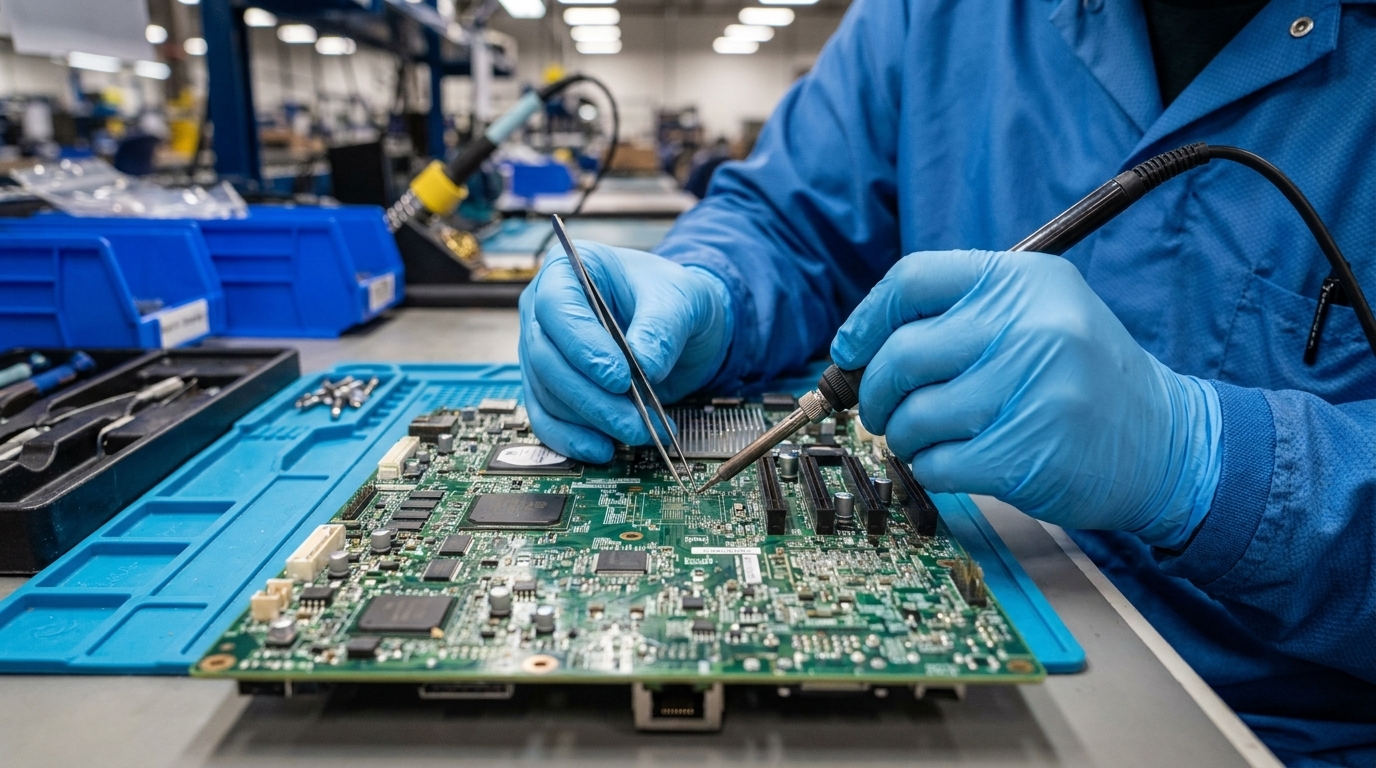
Key Takeaways on Certified Depot Repair Facilities
- Certified depot repair facilities provide centralized, OEM-authorized maintenance for IT hardware, electronics and aerospace components using advanced diagnostics and testing.
- Core certifications include FAA Part 145 for aerospace, ISO 9001/14001 for IT and CMMC/NIST for government contracts, which support compliance and quality.
- Facility types include DoD military depots, FAA repair stations, OEM-authorized IT centers and enterprise reverse logistics hubs.
- Enterprises verify facilities through official directories, OEM portals and documentation, then evaluate scale, compliance and capabilities with structured checklists.
- Premier Logitech maintains ASC status across a broad multi-brand network and delivers end-to-end depot repair solutions; contact Premier Logitech lifecycle experts for enterprise IT programs.
Depot Repair Services for Complex Equipment
Depot repair service uses off-site certified facilities to perform in-depth diagnostics, repairs and refurbishment for complex equipment. These facilities differ from field maintenance because they rely on specialized tools, controlled environments and OEM approvals. They support Level 1 through Level 4 repair capabilities, from basic component replacement to board-level diagnostics and complete system rebuilds.
Three primary facility types support distinct sectors and repair requirements. DoD government and contractor depots focus on military equipment. OEM-authorized service providers support commercial IT and electronics. Commercial maintenance, repair and overhaul facilities handle specialized industrial applications. Enterprise IT leaders increasingly rely on certified depot facilities to manage high-volume warranty claims and reverse logistics operations.
Key Certifications for Depot Repair Facilities
Certified depot repair facilities maintain industry-specific certifications that define which assets they can service and which contracts they can support. FAA Part 145 certification remains essential for aerospace applications. AS9110 adds quality management standards tailored to aviation maintenance organizations.
IT and enterprise facilities rely on ISO 9001:2015 for quality management systems and ISO 14001:2015 for environmental management. Government contractors align with NIST cybersecurity frameworks, meet CMMC requirements for defense contracts and follow SOC 2 Type II for data security. Trade Agreements Act compliance supports eligibility for government procurement.
Because certifications expire and authorizations can change, enterprises confirm current status before engaging a provider. Verification uses official directories such as the FAA repair station database, OEM partner portals and DoD contractor listings. CMMC 2.0 updates in 2026 introduce enhanced cybersecurity controls for facilities handling controlled unclassified information.
Certified Depot Facility Types and Use Cases
Government and DoD facilities include military depots such as Oklahoma City Air Logistics Complex and contractor-operated government-owned facilities. These locations handle classified equipment and weapons systems under strict security protocols, which makes them suitable for defense programs rather than commercial IT assets.
Aerospace FAA Part 145 repair stations focus on aircraft components, avionics and related systems. These facilities maintain specialized approvals for specific aircraft types and component categories, aligning repair processes with aviation safety regulations.
OEM-authorized IT and electronics facilities serve commercial markets through manufacturer partnerships. Microsoft Authorized Service Providers, telecom equipment repair centers and consumer electronics depots operate in this category. Premier Logitech works in this space with a broad ASC network across major IT and telecom OEMs.
Enterprise reverse logistics depots combine repair capabilities with asset recovery, refurbishment and remarketing services. These facilities manage high-volume returns processing, warranty claim management and end-of-life asset disposition for large enterprises, which supports full lifecycle control.
Finding and Verifying Certified Depot Repair Facilities
Enterprises start with official directories to identify candidate facilities. The FAA repair station database lists aerospace facilities, while DoD contractor directories support government applications. OEM partner portals provide authorized service center listings for specific brands and product lines.
Verification continues through direct documentation review. Teams request current ISO certificates, NIST or CMMC compliance attestations and OEM authorization letters. Case studies that match similar equipment types and volume requirements demonstrate practical experience, not just theoretical capability.
Structured checklists help assess scale and compliance capabilities. FMCSA-style inspection protocols offer models for evaluating repair documentation, defect tracking and corrective action procedures. Warehouse maintenance standards support reviews of facility safety, equipment calibration and environmental controls.
Location also influences service performance. National hub sites such as Premier Logitech facilities in the Dallas-Fort Worth region provide centralized access to major transportation networks and nearshore operations, which supports cost-effective and predictable service delivery.
Leading Depot Repair Options for Enterprise IT Assets
Enterprise IT depot repair facilities differ most in OEM authorization breadth, compliance frameworks and reverse logistics integration. Premier Logitech addresses these dimensions with a broad ASC authorization network, compliance programs aligned with TAA, NIST, CMMC and SOC 2 and integrated reverse logistics from its Dallas-Fort Worth hub.
The Premier Logitech facility addresses three core enterprise challenges. High-volume warranty returns require consistent processes and tracking. Vendor fragmentation creates coordination issues across multiple providers. Complex compliance requirements demand unified oversight. A single-vendor model consolidates repair, refurbishment, remarketing and recycling services under one program, which simplifies compliance tracking and scales to handle high return volumes.
Other enterprise-focused facilities include Ingram Micro service centers, which align closely with distribution and configuration services, and Flex operations, which integrate repair with manufacturing. Premier Logitech differentiates through multi-brand ASC coverage and enterprise-focused reverse logistics integration.
Government facilities such as Defense Logistics Agency depots excel in military applications with deep knowledge of defense systems. Security restrictions and specialized missions limit their suitability for commercial enterprise service.
Facilities that combine enterprise experience, multiple OEM authorizations and integrated reverse logistics reduce operational complexity compared with fragmented vendor networks. This combination supports consistent service levels and clearer accountability.
Selection Criteria and Best Practices for Depot Partners
Depot repair facilities warrant evaluation across five dimensions: service scope, compliance frameworks, operational scalability, supply chain visibility and cost structure. Service scope defines whether a facility manages the full asset lifecycle from intake through final disposition. End-to-end capabilities reduce handoff delays and simplify program management.
Compliance requirements vary by industry and customer base. Government contractors rely on the CMMC and NIST frameworks discussed earlier, along with TAA compliance for procurement eligibility. Commercial enterprises emphasize ISO certifications and data security controls such as SOC 2. Tracking renewal schedules and audit cycles helps prevent service disruptions.
Scalability covers volume capacity and geographic reach. Facilities support demand fluctuations without sacrificing quality standards. Transportation management systems and real-time tracking improve supply chain visibility for high-volume operations and time-sensitive assets.
ASC-authorized facilities maintain warranty coverage, which becomes harder to track when multiple vendors handle different brands. Vendor consolidation reduces this management overhead by centralizing warranty claims with one provider. Clear performance metrics with regular review cycles confirm that the consolidated vendor meets expectations. Premier Logitech partnerships support this model through unified service level agreements.
Total program costs extend beyond per-unit repair pricing. Transportation, inventory carrying costs and administrative overhead all influence the business case. Integrated reverse logistics programs improve asset recovery rates and shorten cycle times, which reduces both inventory requirements and administrative effort.
Premier Logitech designs and manages structured depot repair programs for enterprise IT environments. Lifecycle experts discuss consolidation opportunities and performance improvements based on current operations and future growth plans.
Frequently Asked Questions
What is depot repair?
Depot repair refers to centralized off-site maintenance and refurbishment services performed at specialized facilities. These locations use advanced diagnostic tools, clean room environments and OEM-certified technicians. Unlike field service, depot repair supports complex component-level diagnostics, board replacement and complete system rebuilds that require controlled environments.
What certifications are required for IT depot repairs?
IT depot repair facilities typically hold ISO 9001 quality management certification and ISO 14001 environmental management standards. Many also maintain data security frameworks such as SOC 2 Type II. Government contractors align with NIST cybersecurity requirements and CMMC levels based on contract scope. OEM authorizations add warranty support and confirm adherence to manufacturer standards.
How do FAA facilities differ from OEM facilities?
FAA Part 145 repair stations focus on aircraft components and avionics under aviation safety regulations. OEM-authorized facilities support IT equipment, consumer electronics and telecommunications hardware. These OEM facilities provide flexible service options for commercial applications and do not operate under aviation rules.
Does Premier Logitech support OEM warranty programs?
Premier Logitech maintains authorized service center status across a wide range of OEM brands, which enables direct warranty claim processing and repair authorization. This ASC network protects warranty coverage while providing manufacturers with certified repair quality and compliance documentation. The company manages both in-warranty and out-of-warranty repairs through consistent facilities and processes.
What is an Authorized Service Center?
An Authorized Service Center is a repair facility that meets specific OEM requirements for technician training, equipment calibration, quality processes and compliance frameworks. ASC status allows facilities to perform warranty repairs, access OEM parts and technical documentation and maintain manufacturer certifications. This authorization helps ensure repairs match original specifications and preserve warranty coverage.
Conclusion: Building Resilient Depot Repair Programs
Certified depot repair facilities provide essential infrastructure for complex IT asset lifecycles, warranty programs and reverse logistics operations. As 2026 compliance requirements expand and return volumes grow, enterprises benefit from partners with comprehensive certifications, scalable operations and integrated services.
Premier Logitech combines a multi-brand ASC network with end-to-end reverse logistics capabilities to address vendor consolidation and compliance challenges for enterprise IT leaders. The Dallas-Fort Worth hub delivers national reach, nearshore cost advantages and a mature certification framework.
For scalable IT depot repairs aligned with 2026 requirements, talk to a lifecycle expert to explore tailored solutions and program improvements.
