Last updated: April 17, 2026
Key Takeaways
- Enterprise IT faces rising e-waste costs projected to exceed $76B in 2024 and 82M tonnes by 2030, while 2026 regulations such as EPR laws and NIST updates push organizations toward circular strategies.
- Enterprises can follow seven core implementation steps: assess and track assets, extend lifespan through repairs, refurbish and resell or reuse, partner with certified ITAD providers, integrate secure data destruction, explore Product-as-a-Service models, and measure ROI.
- Certified partners such as Premier Logitech deliver 80% asset recovery rates, 20-40% cost reductions, and sub-7-day turnarounds supported by high-volume repair capacity across a broad OEM service network.
- AI-driven capabilities and nearshore operations improve circular performance, reaching 95% recycling purity while maintaining NIST SP 800-88 compliance and meeting TAA and CMMC requirements.
- Partner with Premier Logitech for a custom circular economy assessment that uncovers IT asset value recovery opportunities while supporting compliance.
Audience, Regulations, and Baseline Context
This framework serves supply chain VPs, IT operations directors, and reverse logistics managers in large enterprises, OEMs, and government agencies that manage high-volume IT asset lifecycles. Core terminology includes IT Asset Disposition (ITAD), Return Merchandise Authorization (RMA), Level 1-4 depot repair classifications, refurbishment grading standards, and Product-as-a-Service (PaaS) models.
The regulatory landscape includes 2026 NIST cybersecurity framework updates, Cybersecurity Maturity Model Certification (CMMC) requirements, SEC climate disclosure rules, and Extended Producer Responsibility legislation across 8 states. Organizations implementing asset lifecycle management achieve 10-30% increases in asset efficiency while also supporting carbon reduction through circular material flows. To reach these outcomes within this regulatory context, enterprises need a structured, repeatable approach.
Core Circular EOL Strategies for Enterprise IT
Seven fundamental strategies form the circular economy hierarchy for enterprise IT assets, ordered to retain the most value before moving to lower-value options. Each step builds on the previous one, so extending lifespan reduces repair volume, which then reduces refurbishment and recycling needs while still keeping materials in productive use.
- Extend asset lifespan through predictive maintenance and repair
- Repair components via certified depot services
- Reuse assets internally across departments and locations
- Refurbish equipment for secondary deployment
- Resell assets through certified secondary markets
- Recycle materials through responsible downstream partners
- Partner with certified ITAD providers for comprehensive lifecycle management
The seven numbered sections that follow translate this hierarchy into practical implementation steps, combining related tactics into a single motion where that simplifies execution.
1. Build an IT Asset Tracking Baseline
Comprehensive asset visibility creates the foundation for every circular initiative. Establish inventory auditing and Transportation Management System (TMS) integration so teams can see asset location, condition, and lifecycle stage in one place. Deploy RFID tagging, barcode scanning, and real-time analytics to keep this inventory current.
Premier Logitech’s TMS platform provides serialized tracking across 20+ OEM Authorized Service Centers, which supports consistent, data-driven disposition decisions. Implementation begins with asset discovery scanning to identify all equipment in your environment. After you know what exists, deploy RFID or barcode tagging to enable tracking, then integrate this data into your TMS for centralized visibility.
With tracking infrastructure in place, configure real-time dashboards that surface actionable insights for operations and finance teams. Finally, establish baseline reporting that documents current asset volumes, refresh cycles, and disposal costs; this baseline becomes your benchmark for measuring circular economy ROI improvements.
2. Extend IT Asset Lifespan with Repair and Maintenance
Systematic repair programs keep assets in service longer and reduce premature replacement. Implement structured RMA triage and Level 1-4 depot repair capabilities so high-value equipment moves to repair first, not disposal. Prioritize rapid exchange programs for critical systems to maintain uptime.
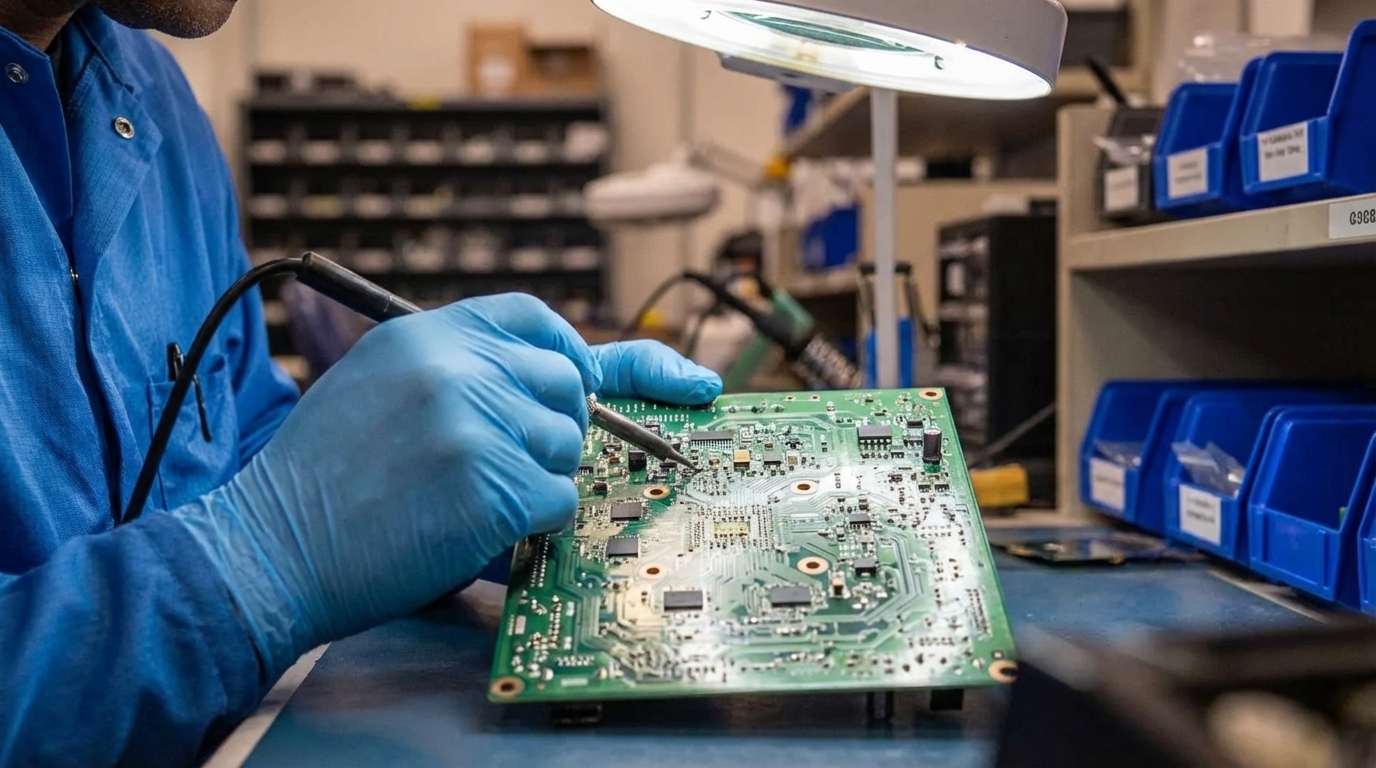
IoT-enabled predictive maintenance reduces downtime by 20-50% and extends operational lifecycles by identifying failures before they disrupt operations. Premier Logitech processes more than 40,000 repairs each week across its authorized service center network, providing L1-L4 repair capabilities for major OEM brands. Rapid exchange programs support business continuity while increasing the ratio of repair over replacement.
3. Refurbish, Resell, and Reuse IT Assets
Structured refurbishment and resale programs unlock value from assets that no longer fit internal needs. Establish consistent asset grading using A, B, and C classifications, then connect each grade to specific secondary market channels. Create parts harvesting programs that feed ongoing repair operations and increase material recovery.
In 2019, the value of raw materials such as gold, silver, and palladium potentially recoverable from e-waste was estimated at $57 billion. Premier Logitech’s certified grading and remarketing programs convert a portion of that theoretical value into realized client savings and asset value recovery. Professional refurbishment brings equipment up to secondary market quality standards while maintaining strict data security protocols.
To understand how much value remains in your current asset inventory, schedule a call with Premier Logitech and review your specific recovery potential.
4. Select Certified ITAD Partners for End-to-End Coverage
Most enterprises require external partners to handle the full range of disposition pathways at scale. Select ITAD providers that hold R2v3, e-Stewards, SOC 2, and NAID AAA certifications so processing remains responsible and data stays secure. Consolidate vendor relationships where possible to simplify compliance reporting and capture economies of scale.
The global ITAD market is projected to grow at a CAGR of 11.7% from 2025 to 2030, driven by regulatory pressure and rising asset volumes. Premier Logitech maintains Trade Agreements Act (TAA) compliance, CMMC certification, and SOC 2 attestation, which together form the certification stack required for many government and regulated enterprise environments. This comprehensive compliance profile, combined with the Dallas-Fort Worth hub and nearshore Mexico operations, enables Premier Logitech to act as a single-vendor solution that meets both regulatory and scalability needs.
5. Embed Secure Data Destruction into Every Pathway
Data protection must remain consistent across all circular routes, including reuse, resale, and recycling. Implement NIST SP 800-88 Rev. 2 compliant data sanitization for every disposition pathway. Define clear protocols for logical wiping, degaussing, and physical destruction based on asset classification and redeployment potential.
Maintain complete chain-of-custody documentation and certificates of destruction so audit teams can verify compliance. Premier Logitech delivers full-suite data destruction services aligned with NIST standards, supporting both reuse-enabling sanitization and secure destruction for high-risk assets. Detailed reporting supports regulatory compliance across federal, state, and industry-specific requirements.
Connect with Premier Logitech’s data security team to confirm that your sanitization protocols align with NIST expectations.
6. Use PaaS and Leasing to Create Closed-Loop IT Flows
Product-as-a-Service and leasing models shift end-of-life responsibility back to vendors and support more predictable refresh cycles. Transition selected asset categories from capital purchases to PaaS agreements where vendors commit to take-back, refurbishment, and responsible recycling. Negotiate lease terms that specify circular design principles, modular upgrades, and defined recovery processes.
Evaluate vendor capabilities for closed-loop material flows, refurbishment programs, and integration with your broader circular supply chain. Within service agreements, define performance metrics for asset utilization, lifecycle extension, and environmental impact reduction so both parties can track results.
7. Measure Circular ROI and Refine the Program
Clear metrics keep circular initiatives accountable and support continuous improvement. Establish key performance indicators that track asset recovery rates, cost-per-ton reductions, and overall circular value generation across your portfolio. Leading ITAD providers achieve faster turnaround times than industry averages, which supports quicker revenue recovery and preserves resale values.
The table below highlights three benchmarks that distinguish high-performing ITAD partners from average providers; use these targets when you evaluate or renew vendor relationships.
| KPI | Target | Premier Logitech Proof |
|---|---|---|
| Asset Recovery Rate | 80% | Client savings delivered |
| Processing Turnaround | <7 days | 40,000+ weekly repair capacity |
| Cost Reduction | 20-40% | Material savings achieved |
Premier Logitech’s performance across these KPIs shows measurable circular impact for enterprise clients, supporting both financial outcomes and sustainability goals.
Common Challenges and Practical Fixes
Fragmented vendor relationships often create compliance gaps and operational inefficiencies. Reduce this risk through single-vendor consolidation with providers such as Premier Logitech that offer end-to-end lifecycle services.
A second frequent challenge involves data security risks during asset disposition. Address this with NIST-compliant sanitization protocols and thorough chain-of-custody documentation that stands up to audits.
Scale limitations can also strain high-volume operations during refresh cycles. Premier Logitech’s Dallas-Fort Worth facilities and nearshore Mexico operations provide surge capacity and geographic redundancy, while OEM authorization across more than 20 brands supports compliant processing across diverse asset mixes.
Measuring Success and Watching Emerging Trends
Successful circular programs combine near-term performance targets with awareness of emerging technologies. Focus on the efficiency gains discussed earlier, and target turnaround times under 7 days across key disposition streams. AI-powered sorting systems achieve 95% purity levels in recycled outputs and cut contamination rates by 85%, which improves both revenue from recovered materials and compliance outcomes.
Looking ahead to 2026, three trends will shape enterprise circular strategies: AI-driven asset tracking for real-time visibility, predictive disposition modeling that selects the highest-value recovery path, and nearshore repair operations that reduce logistics costs and cycle times. To capture these benefits, implement RACI frameworks that define roles, responsibilities, and accountability across circular initiatives so teams can adapt as technology evolves. IT and telecommunication equipment will remain a major contributor to global e-waste recycling market growth, which makes structured programs even more critical.
Frequently Asked Questions
What makes an ITAD partner ideal for circular economy initiatives?
An effective ITAD partner combines relevant certifications with proven operational performance and full lifecycle coverage. Premier Logitech brings R2v3 and TAA certifications, demonstrated client savings, and a broad OEM service network that supports single-vendor circular solutions from sourcing through recycling.
What ROI can enterprises expect from circular ITAD programs?
Enterprises that implement comprehensive asset lifecycle management often see notable cost reductions and meaningful asset value recovery. Premier Logitech clients have realized significant supply chain savings by applying structured circular strategies across their IT portfolios.
How do government agencies ensure compliance in circular IT asset programs?
Government agencies typically require NIST SP 800-88 compliant data sanitization, CMMC certification, and TAA-compliant processing. Premier Logitech maintains CAGE Code 4WAJ9 for federal contracting, SOC 2 attestation, and detailed compliance reporting that supports agency audit requirements.
What e-waste trends will impact enterprise IT in 2026?
IT and telecommunication equipment represent a major share of the global e-waste recycling market, driven by data center refreshes and mobile device growth. The EPR laws mentioned earlier create financial incentives for certified recycling partnerships and accelerate circular economy adoption.
How can enterprises extend IT asset lifespans effectively?
Structured repair and refurbishment programs keep assets productive longer and delay capital spending. The high-volume repair capacity described earlier, combined with rapid exchange programs, helps enterprises extend operational lifecycles while maintaining business continuity.
What impact do EPR laws have on enterprise ITAD strategies?
EPR legislation shifts more disposal responsibility and cost toward manufacturers and their partners. Certified ITAD relationships provide fee reductions and simplified multi-state compliance reporting, which makes circular strategies financially attractive for many enterprises.
Conclusion
These seven circular strategies shift enterprise IT asset management from a cost center into a repeatable source of financial and environmental value. Implementing them with certified partners such as Premier Logitech supports regulatory compliance, data security, and measurable ROI across the complete asset lifecycle.
Talk with a lifecycle expert when you are ready to map these practices to your own IT environment.
